» Site Navigation

2 members and 1,677 guests
Most users ever online was 54,199, 06-29-2026 at 02:43 AM.
» Today's Birthdays
» Stats
Members: 76,111
Threads: 249,260
Posts: 2,573,015
Top Poster: JLC (31,651)
|
-
Re: Ball Python Feeding Guidelines
 Originally Posted by Warren_Booth

I'ts interesting to look at such a feeding chart and consider the pro's the con's. As an evolutionary biologist, herpetologist, and herpetoculturist, I try to absorb as much information regarding the effects of feeding schedules on the snakes physiology. Combine that with dissections of numerous "pet/breeder and wild" boids and pythonids over the years, I get to see the effects of feeding first hand. I posted this before, but I think its relevant.
"The frequency of feeding is something that interests me greatly, due to the dramatic physiological changes that occur rapidly upon feeding. Based on work carried out on Burmese pythons, it was shown that within 48 hours of feeding metabolic rate increases 44 fold, and the plasma triglyceride content increases 160 fold (thus the blood becomes thicker). Within 72 hours major organ specific changes also occur. For example, the small intestines, pancreas, liver, kidneys, and heart, increase in mass by between 40 and 100 fold. These changes last 10 to 14 days before returning to pre-feeding conditions. Physiologically, that is a massive amount of stress on organs. So, the question arises, if we feed on a 5 to 7 day routine, are we maintaining our snakes in a constant state of physiological stress (which may explain the short life span of many pythons and boas in captivity)? Furthermore, if we are feeding on a 5 to 7 day schedule, are the animals effectively utilizing all of the available meal, or are we simply pushing this through their systems with a reduced amount of processing?"
Would love to hear others opinions. Personally, I could not disagree more with a feeding regime of every 3-4 days for snakes up to 200 grams. But that is just me basing it off what we currently know about pythonid physiology.
Warren
Thank you for your insight, Dr. Booth. It's always welcome to hear feedback beyond the hobbyist's perspective. I would be interested in learning about how these physiological changes change throughout a snake's lifetime. How many hatchling snakes were included in the Burmese python research? From my own observations, and through conversations and reading what others have written on this topic, I have found that the actions and growth pattern of hatchling ball pythons indicate that they benefit from being fed more frequently than older snakes.
Originally Posted by silverbill
I think you could easily go with feeding most adults every second week.
Yes - a non-breeding adult could certainly be offered food every other week. Offering once weekly with the occasional skipped meal works as well. As I said on the chart - find what works best for you and your animals.
-
-
Re: Ball Python Feeding Guidelines
Originally Posted by Warren_Booth
I'ts interesting to look at such a feeding chart and consider the pro's the con's. As an evolutionary biologist, herpetologist, and herpetoculturist, I try to absorb as much information regarding the effects of feeding schedules on the snakes physiology. Combine that with dissections of numerous "pet/breeder and wild" boids and pythonids over the years, I get to see the effects of feeding first hand. I posted this before, but I think its relevant.
"The frequency of feeding is something that interests me greatly, due to the dramatic physiological changes that occur rapidly upon feeding. Based on work carried out on Burmese pythons, it was shown that within 48 hours of feeding metabolic rate increases 44 fold, and the plasma triglyceride content increases 160 fold (thus the blood becomes thicker). Within 72 hours major organ specific changes also occur. For example, the small intestines, pancreas, liver, kidneys, and heart, increase in mass by between 40 and 100 fold. These changes last 10 to 14 days before returning to pre-feeding conditions. Physiologically, that is a massive amount of stress on organs. So, the question arises, if we feed on a 5 to 7 day routine, are we maintaining our snakes in a constant state of physiological stress (which may explain the short life span of many pythons and boas in captivity)? Furthermore, if we are feeding on a 5 to 7 day schedule, are the animals effectively utilizing all of the available meal, or are we simply pushing this through their systems with a reduced amount of processing?"
Would love to hear others opinions. Personally, I could not disagree more with a feeding regime of every 3-4 days for snakes up to 200 grams. But that is just me basing it off what we currently know about pythonid physiology.
Warren
I found the article you referenced (found here: http://jeb.biologists.org/content/211/24/3767#F8). The part that caught my eye was the impact that meal size had on these changes. When meal size was varied, the physiological changes were more elevated and prolonged as the meal size increased. All but the smallest sizes of meals used, though, are not recommended as appropriate for feeding ball pythons regularly. For hatchlings, 10-15% is the generally used range. For juveniles and adults, the percentage is considerably lower than that. For those size meals, the elevated responses are largely finished by the 3rd or 4th day.
Here is the figure (Figure A) I'm referring to:
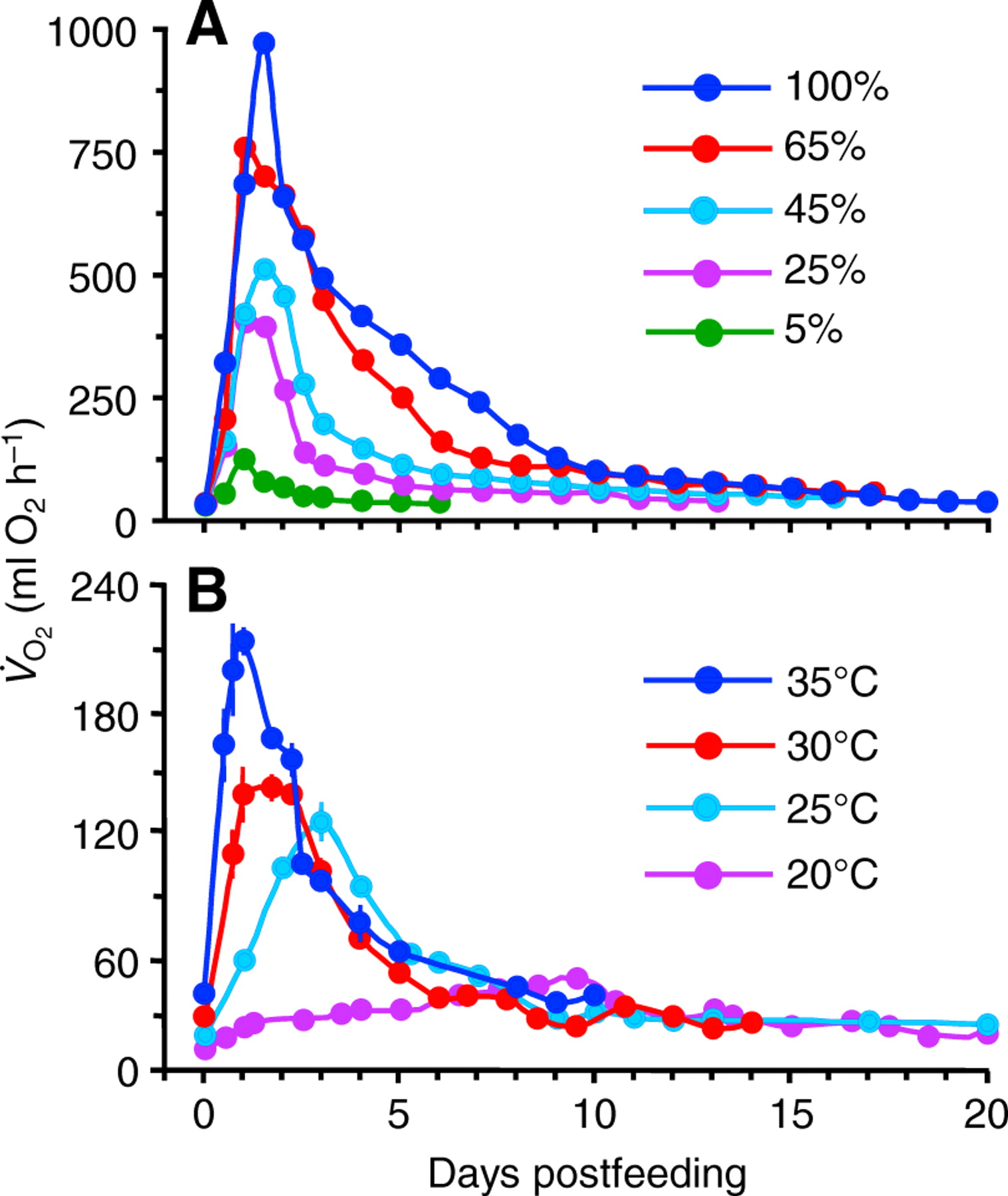
Even in the other figures/images shown in the article, the meal sizes used were 50% (for the body distension images) and 25% (for the remainder of the figures) - both larger than necessary for ball pythons. I just thought it was important to add some context to the numbers you referenced here.
Last edited by Eric Alan; 01-03-2017 at 12:35 PM.
-
-
Hi Eric,
That is an older article. The one that I am referring to was published in the Proceedings of the National Academy of Sciences, U.S.A. 2013. Castoe et al. The Burmese Python genome reveals the molecular basis for extreme adaptation in snakes. 110:20645-20650, however I have seen follow up talks with more data presented at several meetings.
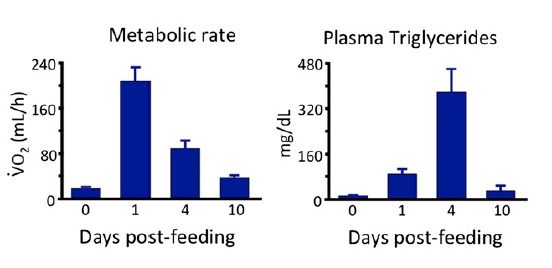
Here are several figures to show what changes are occurring, and the duration for which organ remodeling is taken place. This is for a meal that is 25% of the body weight, which is large for captivity, in general, but not for the wild (given that they are opportunists).
Regarding metabolic rate and blood tryglyceride levels -
and now organ remodelling -
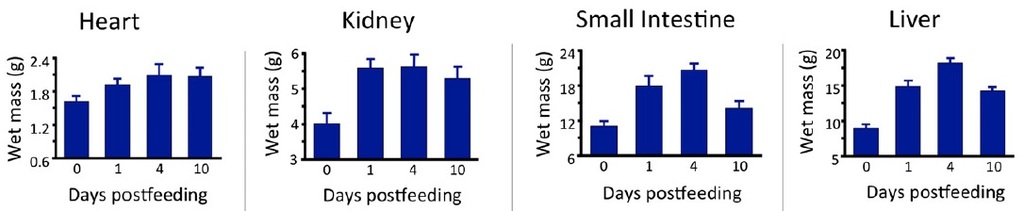
Even if we scale this back to the ~8% to 18% prey size to body size that you recommend, it is clear that organ remodeling is not going to reduce dramatically to 3 to 5 days.
My concern is not growth rate. Look at obesity in America for example. Offer a kid food, 9 times out of 10 if it is their favorite meal they will eat it, and... they will grow. Therefore how do you measure growth rate, and how do you determine a healthy growth rate from an excessive and unhealthy growth rate? You have 3 years experience keeping ball pythons, therefore how can you determine the impact of this feeding regime on the long term health of the animals in your care, or those that you are recommending this to?
I am not trying to be argumentative. That may come across due to the nature of non-tonal text, however I am playing devils advocate here and would ask for scientific data to support such a dramatic and prolonged feeding strategy. Speaking to a very successful boa and python breeder recently, he mentioned that his feeding strategy for ball pythons is very simple. Between September and December he feeds them any time they will eat. The rest of the year, they are not fed. He has had incredible success over a very long time with this method. The other aspect to consider is breeder vs. pet. We know that breeders in general want their animals to be breeding size as quick as possible, but again, what is the long term effect of this on health? I personally have concerns over such a strategy, and simply want people to consider the physiological impacts on the animals. We are in a society that is sadly starting to ignore science. As reptile hobbyists, we should embrace it and learn from it. Therefore, before implementing a feeding strategy, lets see some data supporting it being healthy first. (note, colubrids are a totally different beast. Very high metabolic rates and do not do well with prolonged periods without food).
Regards,
Warren
-
The Following 3 Users Say Thank You to Warren_Booth For This Useful Post:
DavidNDC (12-04-2017),Dumdum333 (03-13-2017),Eric Alan (01-03-2017)
-
One other aspect that is not discussed in this feeding model is defecation rate. That is an important aspect to consider.
Warren
-
The Following User Says Thank You to Warren_Booth For This Useful Post:
-
Registered User


Thank you Eric and Warren! Great information. @ Warren could you please expand on your defecation comment?
I have been feeding my adult BPs every 10-14 days. They would be too dang fat on a 7 day schedule, lol!
4.3 Corns (Ziggy, Maximus, Twix, Henley, Amelia, Akasha, Zahara)
1.1 Rosy Boas (Moonshine, Peaches)
0.1 Licorice Black Rat (Lacey)
1.1 Balls- Special Lesser Leucistic (Raka), Nuclear (Vesta)
1.1 Carpets-Caramel Coastal (Michonne), Highlighter Jungle (Grimes)
-
The Following 2 Users Say Thank You to xcjumper For This Useful Post:
Craiga 01453 (02-14-2017),Eric Alan (01-03-2017)
-
Re: Ball Python Feeding Guidelines
Originally Posted by Warren_Booth
One other aspect that is not discussed in this feeding model is defecation rate. That is an important aspect to consider.
Warren
Yes. What would be considered a normal/healthy rate though? Have there been studies on this?
EDIT: To add to this, I have logged the date and gram weight of every meal, the date of every defecation (not the weight of it - that's too much for even me), and the post-defecation "empty" weight of every animal in my collection since the beginning. Less a few vacations where I couldn't determine the exact dates, the information I have is solid. If you're at all interested, I could certainly share.
Last edited by Eric Alan; 01-03-2017 at 03:00 PM.
-
-
Re: Ball Python Feeding Guidelines
Originally Posted by Warren_Booth
Hi Eric,
That is an older article. The one that I am referring to was published in the Proceedings of the National Academy of Sciences, U.S.A. 2013. Castoe et al. The Burmese Python genome reveals the molecular basis for extreme adaptation in snakes. 110:20645-20650, however I have seen follow up talks with more data presented at several meetings.
Thank you for sharing. It is incredibly interesting to read about the relationship between the genome sequence itself and the resulting physiological and metabolic adaptations in these animals.
Originally Posted by Warren_Booth
My concern is not growth rate. Look at obesity in America for example. Offer a kid food, 9 times out of 10 if it is their favorite meal they will eat it, and... they will grow. Therefore how do you measure growth rate, and how do you determine a healthy growth rate from an excessive and unhealthy growth rate?
I don't have a scientific answer to those questions beyond knowing how to recognize healthy body proportions versus unhealthy body proportions in both people and pythons. The comparison between the two, however, is a stretch and at best we can say that there is a relationship between obesity and longevity for people and pythons alike. David & Tracy Barker, in their book Ball Pythons: Their History, Natural History, Care, and Breeding, had this to say on the subject:
- "If environmental conditions are constant, then the rate of growth is a function of the amount of food that is fed, combined with a particular animal's genetic potential for growth and size. There are strong opinions among herpers about exactly what constitutes the optimal growth rate. We don't know what the optimum growth rate is - but neither do we think anyone else has more than a strong opinion on the subject."
- "Ball pythons that are fed too much become obese. Obesity tends not to be as common in ball pythons as in other python species. As we've mentioned before, ball pythons seem to have a faster metabolism than say, blood pythons, Burmese pythons, or boa constrictors, and P. regius are prone to occasionally stop feeding for periods of several months at a time. Still, we have seen ball pythons that have been overfed and were massively obese."
Originally Posted by Warren_Booth
You have 3 years experience keeping ball pythons, therefore how can you determine the impact of this feeding regime on the long term health of the animals in your care, or those that you are recommending this to?
I never claimed to be working in a silo when I put together this guideline. I appreciate you calling out my experience, though, and questioning my ability to share not only what I've observed myself, but also what I have learned from others during that time. Again, pulling from the Barker's decades of experience:
- "Our schedule for hatchlings and young snakes is to feed them one rodent per meal, two meals per week. They grow very nicely on this schedule. In six months or so, they get big enough that one adult mouse doesn't even make a bulge. At this point in their lives, we move them to bigger cages and start feeding them small rats, one meal per week."
- "Throughout most of the year, we offer a meal to our adult ball pythons every week. It's difficult for us to quantify this any more exactly. We attempt to tailor the frequency and the size of meals to the individual snake, and there is quite a variation from snake to snake as to exactly what and when they eat. We may offer and they might refuse, or they might be hungry but we skip a meal. If they are getting too heavy, we may reduce their intake, usually not by fewer meals but by smaller meals. If they need to gain some weight and bulk, we might feed them larger rats or we might feed them more frequently for a while."
- "We try to keep each snake at a good level of weight throughout its life, and the snakes do the growing. When they are young and growing fast, we have to feed them a lot in order to keep them at a good level of weight, with good fat reserves, but not fat. We might offer a young ball python 70 to 80 meals in the first year. Older, mature snakes have a much slower rate of growth: only 20 to 30 meals a year are necessary to keep a mature snake at a good level of weight, heavy and solid, but without taut skin or scales spread around the posterior body."
Originally Posted by Warren_Booth
I am not trying to be argumentative. That may come across due to the nature of non-tonal text, however I am playing devils advocate here and would ask for scientific data to support such a dramatic and prolonged feeding strategy. Speaking to a very successful boa and python breeder recently, he mentioned that his feeding strategy for ball pythons is very simple. Between September and December he feeds them any time they will eat. The rest of the year, they are not fed. He has had incredible success over a very long time with this method. The other aspect to consider is breeder vs. pet. We know that breeders in general want their animals to be breeding size as quick as possible, but again, what is the long term effect of this on health? I personally have concerns over such a strategy, and simply want people to consider the physiological impacts on the animals. We are in a society that is sadly starting to ignore science. As reptile hobbyists, we should embrace it and learn from it. Therefore, before implementing a feeding strategy, lets see some data supporting it being healthy first. (note, colubrids are a totally different beast. Very high metabolic rates and do not do well with prolonged periods without food).
Regards,
Warren
I don't take this as being argumentative. It did seem out of place to be called out based on my own experience, but I'm not one to shy away from that either - I'm well aware of my limitations. Having said that, until such a scientific feeding strategy exists, I'm going to keep feeding my animals based on my own experiences and those of others who have much more experience than I. I don't believe the guideline I shared here is dramatic in the least bit and it, as I shared above in the case of the Barker's, has also proven to have incredible success over a very long time. I simply combined these pieces of information into this easy to follow guide.
After all of that, I feel I need to quote this excerpt from this guide one more time:
- "Even with the above advice, it is important to keep in mind that there is no one right way to feed a ball python. Find what works for both you and your animals and stick to it!"
And one last quote from David & Tracy:
- "In general, it is a good idea to keep a feeding record for every snake. The problem with records, however, is that for some keepers they become rigid schedules. The keeper will look at the feeding record to decide when to feed a snake instead of looking at the snake. Doing this is a terrible mistake, a manifestation of the tendencies of keepers to seek the security of a hard and fast recipe for the maintenance and husbandry of their snakes. Indeed, much of herpetoculture can be broken down into discrete manageable parts, but the hands-on work with the snakes themselves - the feeding, cleaning, and breeding - requires careful study and evaluation of each snake. Decisions need to be made for each individual snake."
Best regards,
Eric
-
The Following User Says Thank You to Eric Alan For This Useful Post:
Thomasrorvig (06-17-2018)
-
Re: Ball Python Feeding Guidelines
Some great information coming from this discussion.
As stated do what's best for you and your snake is always the priority, I wanted to move up in prey size but my reptile guy told me to wait because she has a small head/throat, so feed x2 instead of 1 large until she grows a bit more.
Again I'll say, a discussion on this forum would be an all out brawl on most others (I can only speak to non snake related forums), it's such a relief to be a member and learn from all your experience. For that I thank you all.
Ball Python
0.1 Lesser (Lucille) local pet store
Boas
0.1 Caulkers Cay (CC) from TJ Blevins (Second City Constrictors)
1.0 Sunglow het moonglow (Sonny) from Dustin Dirnberger
1.0 BCI - DH Sharp Snow (Bob) from TJ Blevins (Second City Constrictors)
1.0 Brazillian Rainbow Boa (Babylon) from Ike Lightener (Ike's Exotics & Aquatics)
Pythons
0.0.1 Unknown/undocumented rescue (Roger)
1.0 Northern White Lip (Solo)
Cats
1.1 Domestic short hair (Esther and James)
Snake Wishlist
Drymarchon Malanurus (Black Tail Cribno)
SD/D Retic
Woma or Black Headed Python
Other Reptile Wishlist
Poison dart frogs
-
The Following 4 Users Say Thank You to BR8080 For This Useful Post:
andrewross8705 (03-13-2017),Craiga 01453 (02-14-2017),DavidNDC (12-04-2017),Eric Alan (01-04-2017)
-
***EDIT***
That being said, I still laminated it.
Last edited by BR8080; 01-04-2017 at 03:28 AM.
Ball Python
0.1 Lesser (Lucille) local pet store
Boas
0.1 Caulkers Cay (CC) from TJ Blevins (Second City Constrictors)
1.0 Sunglow het moonglow (Sonny) from Dustin Dirnberger
1.0 BCI - DH Sharp Snow (Bob) from TJ Blevins (Second City Constrictors)
1.0 Brazillian Rainbow Boa (Babylon) from Ike Lightener (Ike's Exotics & Aquatics)
Pythons
0.0.1 Unknown/undocumented rescue (Roger)
1.0 Northern White Lip (Solo)
Cats
1.1 Domestic short hair (Esther and James)
Snake Wishlist
Drymarchon Malanurus (Black Tail Cribno)
SD/D Retic
Woma or Black Headed Python
Other Reptile Wishlist
Poison dart frogs
-
The Following User Says Thank You to BR8080 For This Useful Post:
-
BPnet Veteran
Re: Ball Python Feeding Guidelines
Originally Posted by BR8080
Some great information coming from this discussion.
As stated do what's best for you and your snake is always the priority, I wanted to move up in prey size but my reptile guy told me to wait because she has a small head/throat, so feed x2 instead of 1 large until she grows a bit more.
Again I'll say, a discussion on this forum would be an all out brawl on most others (I can only speak to non snake related forums), it's such a relief to be a member and learn from all your experience. For that I thank you all.
I was actually just looking for information about feeding because my girl has a small head/throat but a rather large body. I've been feeding her x2 as well because I don't want to risk a regrurg.
Thanks for this sticky. I was basing the size of the prey based on the size of the snake and if there was a visible lump and increasing once there was no longer a lump. The exception being the above.
-
Posting Permissions
- You may not post new threads
- You may not post replies
- You may not post attachments
- You may not edit your posts
-
Forum Rules
|









 Reply With Quote