» Site Navigation

1 members and 1,763 guests
Most users ever online was 54,199, 06-29-2026 at 02:43 AM.
» Today's Birthdays
» Stats
Members: 76,104
Threads: 249,252
Posts: 2,572,976
Top Poster: JLC (31,651)
|
-
Registered User

My rat litters + hidden gene!
I recently got my first rats to keep as feeder breeders. I've had rats as pets before. I feel a bit uncomfortable about buying prekilled because I don't know what they ate, how they lived and how they died, all of which feels very important for me.
I picked the rats up from an animal store, the animals themselves was imported from the neatherlands of all places. It's just that the few big suppliers of rats have had all their contracts here torn because they mass produced and sent out sick animals full of fleas and diseases, and since there are no breeders here they had to import animals from other places. Since I am going to use them as feeder breeders it didn't bother me that much, they were all healthy and nice looking, the males are so nice to handle too, real gentlemen.
I bought two females and two males, all 11ish weeks old from a pet store and brought them home. The lady in the store couldn't guarantee that the rats weren't related, but I figured one mating wouldn't hurt, and decided I'd just get new males for the next generation.
I picked up a black and white hooded male, one really nice agouti male, one mismarked baraback agouti female, and one almost good agouti hooded female.
The black male and the mismarked bareback agouti female mated within days, and I planned on checking if she carried the black gene by doing this cross.
I figured she would have a small litter since she was so young, and only expected agouti hooded het black and possibly black hooded, but they threw a surprise party at me, since this is the 16 babies (!) strong litter:
After 11 hours:

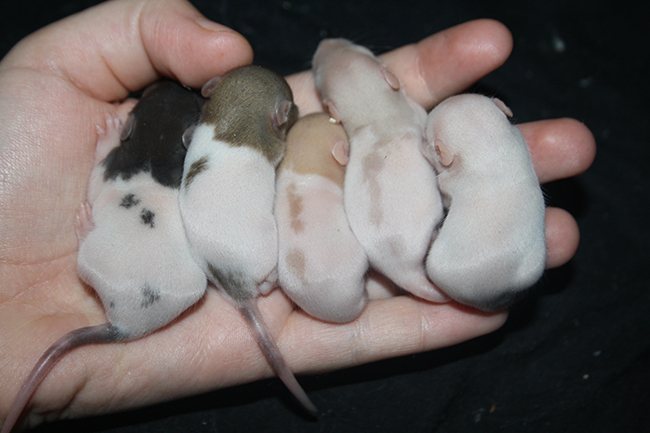
After taking this pic, I noticed that a few babies had dark eyes, and a few of them have bright pink eyes. I figured there MIGHT be something going on, OR they may just take a little longer to pigment up.
This is after 48hrs:

Still very pink! So I either have albino or pink eye cream body type coloration going on, which is awesome!
This is after 72hrs (3rd day):
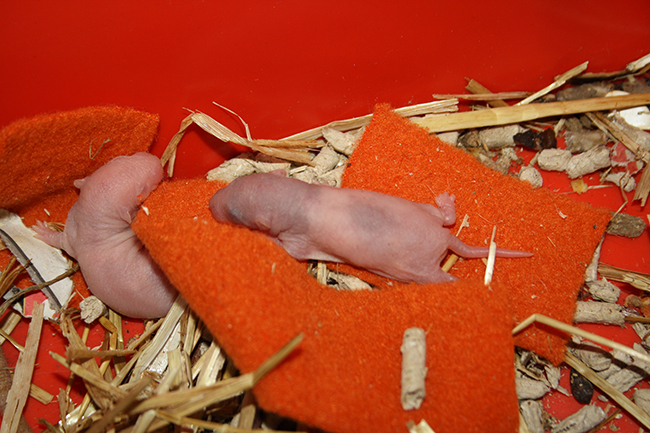

As you can see I have some hooded babies starting to color up, everyone with dark eyes are currently pigmenting up, but the pink eyes are still bright and shiny! I hope it's cream gene and not albino, because the creme colorations are so pretty O.O
And these babies were born on Friday the 13th! I was so scared something would go wrong, because I always have such bad luck on that day, but instead my young female delivered 16 babies that she is caring for with passion, and also showed me some hidden genes! Now I'm actually glad I mated her to her possible brother, otherwise I would never have known! Getting new males for the females I'm keeping from this mating though, don't want to inbreed them too much.
So far everything is going well, all the babies are plump and fat, and growing like weeds!  I just wanted to share my first awesome litter of rat pups with you all! I will post more picutres as they put on their fur later, but I think I saw one that's really getting dark fast, the others are more redish-brown dark, so I think the mother is het for black and for albino/creme I just wanted to share my first awesome litter of rat pups with you all! I will post more picutres as they put on their fur later, but I think I saw one that's really getting dark fast, the others are more redish-brown dark, so I think the mother is het for black and for albino/creme
I'll keep you updated on this litter! I also have three black and white varigated x black hooded (het creme/albino) coming up, and one black hooded (het creme/albino) x roan litter coming up in the next few weeks. Getting all pumped up now!
-
-
Congratulations! It's always fun seeing recessives come out. 
Inbreeding isn't too bad in rats, it just depends on what you have. If there are deleterious genes in the animals' bloodline, those may come out with inbreeding. Outcrossing won't make the traits go away, it will just take longer for them to come out, while also risking spreading them throughout the bloodline (so when they do come out, you won't know where to turn and may have to scrap the whole line if its a bad enough trait). With inbreeding you'll find out it's there, and can take appropriate action to breed away from it or get rid of it. Likewise if there are desirable genes (like the recessive coloration you are seeing in this litter), inbreeding can bring those genes out too, and you can select for them. Neither inbreeding, linebreeding, nor outcrossing are bad in and of themselves, they are just tools. What makes them good or bad depends on how you use them.
Why keep a snake? Why keep any animal? Because you enjoy the animal, find something beautiful and fascinating about it, and it fits seamlessly into your lifestyle.
-
-
Registered User
Re: My rat litters + hidden gene!
 Originally Posted by sorraia

Congratulations! It's always fun seeing recessives come out.
Inbreeding isn't too bad in rats, it just depends on what you have. If there are deleterious genes in the animals' bloodline, those may come out with inbreeding. Outcrossing won't make the traits go away, it will just take longer for them to come out, while also risking spreading them throughout the bloodline (so when they do come out, you won't know where to turn and may have to scrap the whole line if its a bad enough trait). With inbreeding you'll find out it's there, and can take appropriate action to breed away from it or get rid of it. Likewise if there are desirable genes (like the recessive coloration you are seeing in this litter), inbreeding can bring those genes out too, and you can select for them. Neither inbreeding, linebreeding, nor outcrossing are bad in and of themselves, they are just tools. What makes them good or bad depends on how you use them.
Ah, that actually makes sense And I'm glad to see such a big healthy litter, so it doesn't look like they are suffering from it yet like you say. But I sure was surprised, seeing those pink eyes, rofl! I did notice it quick though, I'm happy that I did, or I might have freaked out later, hahaha xD
-
-
Registered User
-
-
Registered User
Re: My rat litters + hidden gene!
I meant five colors, rofl! xD
-
-
left to right ... looks like
Black, agouti, fawn, not sure, champagne I think, REW aka Red eye white aka albino
Last edited by snakesRkewl; 09-23-2013 at 12:46 AM.
Jerry Robertson

-
-
Registered User
Re: My rat litters + hidden gene!
Originally Posted by snakesRkewl
left to right ... looks like
Black, agouti, fawn, not sure, champagne I think, REW aka Red eye white aka albino
Ahw man, I really hope so! Yeah, there were two blacks and four agouti hooded in the litter, those I'm sure what they are.
I really hope it's fawn/silver fawn though, I LOVE that color. It could still be himalayan or something like that, I think they look creme/brown before they fade out.
Holding my fingers crossed for silver fawn and champange though O.O Have two orange females and that one pale female.
Oh, and they are PEW (pink eye white) if they stay white, since they are pink eye, not red eye :3 and there are two kinds, the albino is a (c) locus mutation, and PEW is a pink eye mutation, not always the same thing genetically but in the end they look the same. For now I just don't know which one I've got.
Last edited by bunnykit; 09-23-2013 at 01:26 AM.
-
-
Gratz, that is a very cool litter.
-
-
i completely disagree about inbreeding. i mean, i agree that for one generation its fine. but apart from that, i differ with much of what sorraya says.
these are not BPs but mammals.
for mice or rats with quite a natural gene pool, and maybe some morphs, inbreeding is always bad. it gets worse if it continues. disabilities and deleterious recessive traits will pop up at much higher rates than in ball pythons, or reptiles. ok you did it for one generation, babies look healthy, its fine, dont continue.
then there are the old pure thoroughbred lab mice / lab rat lines. since they are being kept completely seperate from any natural rats/mice, and from other lines, they are basically subspecies. some of these lines are up to 100 years old. their genome is completely different: they are all almost completely genetically identical. a natural mouse is homozygous for some genes and heterozygous for others, and some genes are present only in some individuals. a lab mouse or rat is homozygous for virtually all of the genes present in the genome. here inbreeding does not matter, its meaningless, because differences in the genome between individuals are close to zero and the inbreeding factor / homozygousness is already close to 100%.
lab rats are bred that way to get rid of any randomness, and so that you can just download the full genome online and know that your individual lab rat is a close to perfect copy of the genome you just downloaded.
so you have 2 options: get a pure line of lab rats from a professional lab animal breeder, you should pick a line that is used in so many scientific studies that its all over the scientific literature. keep the line pure, they will all be identical, inbreeding will not matter. absolute purity, but also no morphs, no variation.
or, if you want variety and morphs and stuff, avoid inbreeding, i mean it. they are mammals, and you dont know the genetics but they are obviously diverse, and mammals are very vulnerable to inbreeding.
if you just inbreed a sample of a naturally diverse gene pool, and try to eliminate recessive issues, you are in over your head in a gigantic project that requires dozens of generations, several parralel lines, years of work, and maybe genetic testing. also along the way there will be several setbacks due to serious genetic issues, forcing you to scrap entire lines and to split other lines to replace them. Dont go there. buy a line that some other person purified decades ago and that is proven by full genome sequencing.
-
-
Re: My rat litters + hidden gene!
Originally Posted by Pythonfriend
i completely disagree about inbreeding. i mean, i agree that for one generation its fine. but apart from that, i differ with much of what sorraya says.
these are not BPs but mammals.
for mice or rats with quite a natural gene pool, and maybe some morphs, inbreeding is always bad. it gets worse if it continues. disabilities and deleterious recessive traits will pop up at much higher rates than in ball pythons, or reptiles. ok you did it for one generation, babies look healthy, its fine, dont continue.
then there are the old pure thoroughbred lab mice / lab rat lines. since they are being kept completely seperate from any natural rats/mice, and from other lines, they are basically subspecies. some of these lines are up to 100 years old. their genome is completely different: they are all almost completely genetically identical. a natural mouse is homozygous for some genes and heterozygous for others, and some genes are present only in some individuals. a lab mouse or rat is homozygous for virtually all of the genes present in the genome. here inbreeding does not matter, its meaningless, because differences in the genome between individuals are close to zero and the inbreeding factor / homozygousness is already close to 100%.
lab rats are bred that way to get rid of any randomness, and so that you can just download the full genome online and know that your individual lab rat is a close to perfect copy of the genome you just downloaded.
so you have 2 options: get a pure line of lab rats from a professional lab animal breeder, you should pick a line that is used in so many scientific studies that its all over the scientific literature. keep the line pure, they will all be identical, inbreeding will not matter. absolute purity, but also no morphs, no variation.
or, if you want variety and morphs and stuff, avoid inbreeding, i mean it. they are mammals, and you dont know the genetics but they are obviously diverse, and mammals are very vulnerable to inbreeding.
if you just inbreed a sample of a naturally diverse gene pool, and try to eliminate recessive issues, you are in over your head in a gigantic project that requires dozens of generations, several parralel lines, years of work, and maybe genetic testing. also along the way there will be several setbacks due to serious genetic issues, forcing you to scrap entire lines and to split other lines to replace them. Dont go there. buy a line that some other person purified decades ago and that is proven by full genome sequencing.
I have to disagree with you, pretty much completely.
Lab rats and mice are not a subspecies, they are the same species as pet/feeder rats and mice. They are no different morphologically, their chromosomes are the same, and the only differences in genetics is what genes and alleles were selected for or against in the lab rats and mice. Lab rats and mice were inbred for many generations, and during that time different lines and strains were developed for different purposes. Some were developed for control purposes, some selected for cancers, some for diabetes, some for obesity, etc. This was all achieved through carefully recorded, well monitored, and highly selective inbreeding. Through inbreeding those genes coding for that desired trait were selected for, while those genes coding for undesired traits were selected against.
The same thing can be and is achieved in pet/feeder rats and mice. The keys again are records, monitoring, and selection. It does not take hundreds of years either. It doesn't have to take many generations, it depends on what you are starting with, how often you breed, how good your records are, and how careful your selections. Is inbreeding going to bring out deleterious traits? Sure is, but not because it is causing those traits, it's because those traits are already there. BECAUSE of inbreeding you KNOW those traits are there and can select against them. If you don't inbreed, the trait is still going to be there, but you don't know it. You keep breeding the rats and potentially spread that trait throughout your entire colony (can't call it a bloodline if you aren't linebreeding or inbreeding). When it does pop up, you don't know where it came from or how to get rid of it, and you WILL have to scrap ALL your rats. Will you have to scrap some lines while inbreeding or linebreeding? Sure will, that's part of breeding. Nothing is ever assured, and nothing is ever perfect. That's why you have to have goals and you have to select for those traits you desire.
Just speaking from my personal experience, I bred pet show rats for 10 years (and now with my feeder colony my experience breeding rats is greater than 10 years). During that time I practiced careful, well monitored and recorded, and selective linebreeding and inbreeding. I worked with a number of different lines, some of which were unknowns, some of which were partially unknown, some of which weren't the greatest and some of which had good records for many generations. I saw the MOST and QUICKEST improvements in my rats, in health, temperament, and confirmation, when I did inbreed and linebreed. The slowest and most inconsistent improvements, if there were any at all, occurred in outcrossing. In my personal experience of breeding rats for more than 10 years, real improvements only occurred with inbreeding and linebreeding, while outcrossing really served no purpose except to produce more rats. During the last 3 or 4 years I was breeding pet show rats, I was doing some very heavy inbreeding and linebreeding. By this I mean father to daughter, full siblings, grandoffspring to grandparents, etc. I was NOT breeding many litters either, only 2-6 litters PER YEAR (that's an average of 1 litter every 2 to 6 months, not litters every week as most feeder operations have). During that time, with that number of litters, I saw a decrease in ALL health problems. Hind-end degeneration decreased to almost 0%, congestive heart failure was eliminated, respiratory disease decreased from nearly 25% to less than 10%, tumors decreased from 30-40% by 2 years of age to less than 18%, and life expectancy increased from an average of 20 month to over 24 months. If inbreeding was so awful, I would not have seen those kinds of results, and in 10 years of breeding, even with the low number of litters I had each years (especially the last few years), that is not a matter of luck either. Like I said before, the key is careful selection, record keeping, and monitoring.
Now if I saw those kinds of results with 2-6 litters a year in just a couple years, imagine what kind of results I would see if I bred my feeder rats like that. The improvements would happen in a much shorter span of time, and I'd have a much greater gene pool to work with, since I would be producing much higher numbers.
The major problem with outcrossing is you simply do NOT know what you are working with. Inbreeding brings it all out, outcrossing does not. Outcrossing gives you multiple "hidden genes", some good, some very bad. Eventually those hidden genes are going to come out, but you don't know when, or in what way, or how many animals will be or are affected. Inbreeding is like opening the closet door and letting those skeletons out. You inbreeding, and it brings them out, now you can see them, now you know what you have, now you know where it came from, and you can take some action to eliminate it. Is it easy? Not always. Does it have to be hard? Well I guess that depends on what you consider "hard".
Think about it biologically too. I've seen it said multiples times on this forum that ball pythons are very tolerant of inbreeding. Why? Because in the wild they aren't holding large territories and moving around a lot, they have to breed with what they've got, whether or not that animal is their mother, father, brother or sister. So how does that differ from mammals? Depends on the mammals. Genetically meiosis and mitosis work the same way. When mammals breed, the offspring get half their genes from one parent, and half from the other parent, same way it happens in snakes. Inbreeding doesn't make the genes mutate, same as snakes. The difference between mammals and snakes is what genes do and don't occur, and perhaps the rate of natural mutation (which is variable, and may be due to encoding errors or due to environmental factors such as radiation or goodness knows what else). But look at the biology of rats... they are a small mammal, food to many other animals, live in colonies, don't hold large territories, and don't exactly travel over large distances. Those last two traits are two of the very reasons given for why it's ok to inbreed ball pythons, hmmm..... If an animal is living in a colony, the only thing that's going to prevent inbreeding in the wild is natural dispersion. Some species do disperse, others don't. Rats generally don't. When wild rats are weaned and leave their nest, they don't suddenly decide to run off for miles and miles to make sure they don't breed with their father or mother, they stay pretty close. Moving away from the colony is a death sentence, because the rats don't know where food resources are, where shelter is, and emigration increases their chances of encountering a predator. Staying close to home means inbreeding IS going to occur naturally. Thus, rats (and mice) are actually very tolerant of inbreeding. That's why the laboratories can get away with inbreeding for so many generations. If the animals were not biologically tolerant of it to start with, the labs can't change that (these animals aren't computers). This DOES differ from other species, such as many big cats, where offspring are forced to disperse away from their natal territory. Pack animals, such as canines or many species of livestock, may have some inbreeding or linebreeding occurring naturally, but because they are so much more mobile, and hold so much larger territories, the rate is much smaller than in relatively immobile animals such as rats. Migrating animals are especially less likely to inbreed naturally because they are moving around and thus encountering other groups who are bringing in other genes. This is why inbreeding is less tolerated by species such as horses, dogs, and cats.
Why keep a snake? Why keep any animal? Because you enjoy the animal, find something beautiful and fascinating about it, and it fits seamlessly into your lifestyle.
-
Posting Permissions
- You may not post new threads
- You may not post replies
- You may not post attachments
- You may not edit your posts
-
Forum Rules
|





 Reply With Quote