» Site Navigation

3 members and 1,706 guests
Most users ever online was 54,199, 06-29-2026 at 02:43 AM.
» Today's Birthdays
» Stats
Members: 76,098
Threads: 249,238
Posts: 2,572,918
Top Poster: JLC (31,651)
|
-
Re: Desert Storm???
I want a desert clown sooooo bad...
-
-
Re: Desert Storm???
 Originally Posted by spitzu

I want a desert clown sooooo bad...
BG has to admit....they are awesome.
-
-
Re: Desert Storm???
I saw a pic of Ben Renick's adult female Desert glowing and it looks like a nice healthy breeding girl
I used to hear the same thing about pieds(back when there wasn't that many) and therefore you should raise and breed hets, but I have a female pied that has grown like a weed and has reached breeding weight right on schedule.
Just because someone has a bad experience with an animal and posts it online doesn't make it law, that's all I saying
-
-
Re: Desert Storm???
Originally Posted by West Coast Jungle
I saw a pic of Ben Renick's adult female Desert glowing and it looks like a nice healthy breeding girl
I used to hear the same thing about pieds(back when there wasn't that many) and therefore you should raise and breed hets, but I have a female pied that has grown like a weed and has reached breeding weight right on schedule.
Just because someone has a bad experience with an animal and posts it online doesn't make it law, that's all I saying
BG couldn't agree more with your last statement. The question is whether or not it's just "someONE" and whether it's just "an" animal BG would say.
ps. Wonder if someone is regretting mentioning BG's name right about now. You should have never listened to my favorite donut eater. You have put BG in a bad spot to defend himself.... and he's not too happy about it. For this transgression, BG continues this game. For this transgression, BG continues this game.
-
-
Registered User

So in these 10 years only the male deserts and desert combos have been carrying the gene on? hard to believe...
0.1 normal
1.0 albino
1.0 chesapeake bay retriever
-
-
Re: Desert Storm???
Originally Posted by mgt1216
So in these 10 years only the male deserts and desert combos have been carrying the gene on? hard to believe...
BG has to ask. If that was in fact true, why would that be hard to believe?
-
-
Re: Desert Storm???
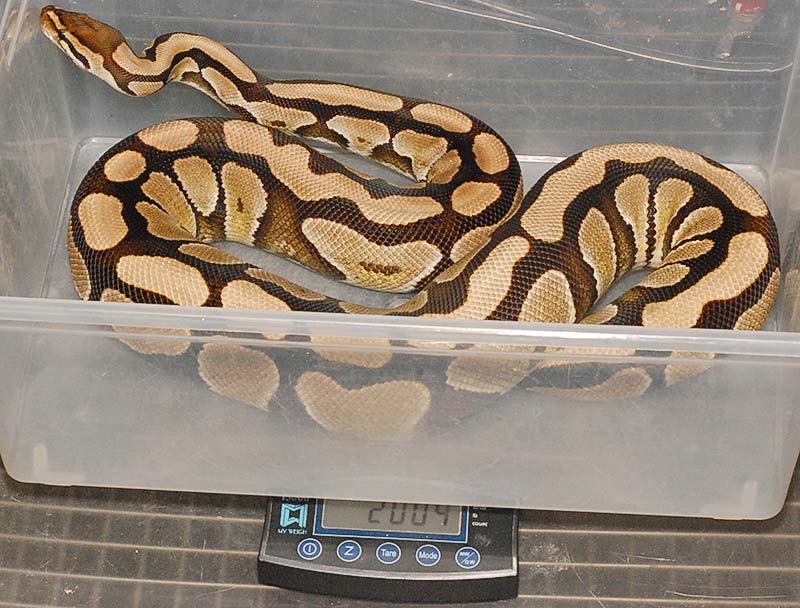
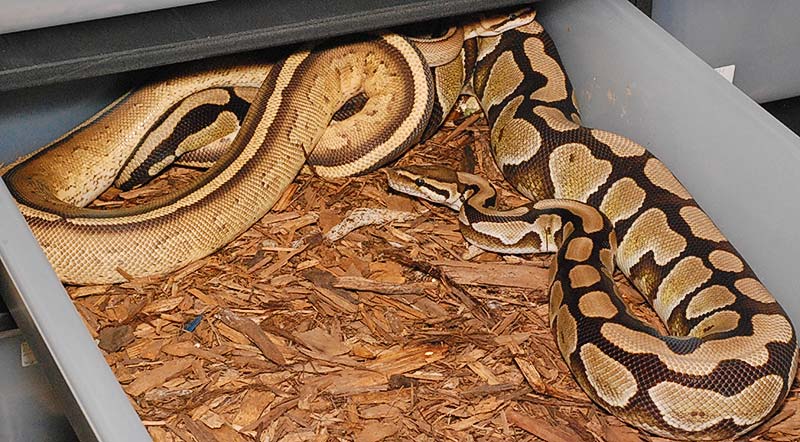
I purchased my Desert Female at the 2007 Daytona show from Stan Chiras. The first year she got up to 800 grams in weight before shutting down. The next year she got up to about 1100 grams before shutting down again. The third year she was around 1450 grams in weight at the start of 2010 breeding season but I decided to wait one more year before trying her. This year she was at about 1750 grams when I first started pairing her up on 1/10/11. She has been ravenous since she started breeding eating every time I offer her food. I took the following picture on Friday afternoon after a shed.
I took the following picture of her on Sunday morning 3/27/11 breeding with my Male Superstripe.
Originally Posted by JayCee
Just found this little tidbit posted in 2009.
Both Stan Chiras and Peter Kahl, unbeknown to them, were working with two separate imported Desert balls lines at the time. It was first assumed that the desert morph was recessive, because they resembled the desert ghost mutation. While comparing breeding efforts, they later proved that the Desert gene was a simple co-dominant mutation. In theory, 50% of a clutch should be Deserts when bred to a normal phase ball python.
In conversation, Stan explained to me that the Desert ball appears to be somewhat of a dwarf sized ball python that will not bulk up in size as some balls do. The male Desert I had purchased from Stan resembled more a corn snake than a ball python at its yearling size. Stan insisted for me to pair him up with some select females this season. “He may be little, but he’ll do the job”, he assured me.
We can only imagine what a super desert would look like if it proves itself to exist this season. In the meantime, we are proud to work with our Chiras line Desert ball. One step closer, in our pursuit of the Desert Spider.
I think Stan’s comments on the Desert possibly being a dwarf mutation might have been jumping the gun a little bit don’t you think.
-
-
Re: Desert Storm???
Originally Posted by Albey
I purchased my Desert Female at the 2007 Daytona show from Stan Chiras. The first year she got up to 800 grams in weight before shutting down. The next year she got up to about 1100 grams before shutting down again. The third year she was around 1450 grams in weight at the start of 2010 breeding season but I decided to wait one more year before trying her. This year she was at about 1750 grams when I first started pairing her up on 1/10/11. She has been ravenous since she started breeding eating every time I offer her food. I took the following picture on Friday afternoon after a shed.
I took the following picture of her on Sunday morning 3/27/11 breeding with my Male Superstripe.
I think Stan’s comments on the Desert possibly being a dwarf mutation might have been jumping the gun a little bit don’t you think.
We'll have to wait and see now won't we? BG has never stated what he thinks/knows. Your ONE animal is not old enough to prove anything since Balls can easily reach twice that weight. Maybe you're right....maybe you're not.
-
-
Registered User

Re: Desert Storm???
Originally Posted by Big Gunns
We'll have to wait and see now won't we? BG has never stated what he thinks/knows. Your ONE animal is not old enough to prove anything since Balls can easily reach twice that weight. Maybe you're right....maybe you're not.
I agree with you 99% of the time BG, and I'm half-way agreeing with you now. But, you have to admit that rarely a ball python reaches 4000 grams and wears the weight in good health. Some females do get rather big, but most only get 2000-2500. I feel lucky if a female breaks 3000 grams.
Not to say that there isn't any truth about the Desert gene possibly being a "dwarf" like gene, but I know several people who own deserts... males and females.. and I've never heard them mention anything like what I'm reading here about their Deserts. I've seen these animals several times in person. Next to other ball pythons that are similar in age, and they look about the same/normal size and weight for their age.
I also thought about this. With as many deserts and desert combos that Pro Exotics have produced, I'd be VERY hard pressed to believe any of this.
IMHO I wouldn't be scared at all to purchase a desert or desert combo.
-
-
Re: Desert Storm???
Originally Posted by PassionsPythons
I agree with you 99% of the time BG, and I'm half-way agreeing with you now. But, you have to admit that rarely a ball python reaches 4000 grams and wears the weight in good health. Some females do get rather big, but most only get 2000-2500. I feel lucky if a female breaks 3000 grams.
Not to say that there isn't any truth about the Desert gene possibly being a "dwarf" like gene, but I know several people who own deserts... males and females.. and I've never heard them mention anything like what I'm reading here about their Deserts. I've seen these animals several times in person. Next to other ball pythons that are similar in age, and they look about the same/normal size and weight for their age.
I also thought about this. With as many deserts and desert combos that Pro Exotics have produced, I'd be VERY hard pressed to believe any of this.
IMHO I wouldn't be scared at all to purchase a desert or desert combo.
Big Gunns never said they were a "dwarf" Ball Python. As a matter of fact, he hasn't said anything either way. He does know the real "truth" though. He is just tying to decide whether he should give them the thumbs up, or throw them and their breeders in the fish fryer.
Absolute 100% positive "truth" that is. The whole "truth" and nothing but "THE TRUTH". Let BG make that perfectly clear. He wouldn't even be posting on this thread, but although it rarely happens......someone got BG a leeetle po'd(BG realizes this person was misled, but still BG is po'd). When that happens....you had better be on the right side of the argument.
ps. BG will agree with you also, most Balls do not get huge. BG was really trying to point out that he only has one.
-
Posting Permissions
- You may not post new threads
- You may not post replies
- You may not post attachments
- You may not edit your posts
-
Forum Rules
|








 Reply With Quote