» Site Navigation

2 members and 1,512 guests
Most users ever online was 47,180, 07-16-2025 at 05:30 PM.
» Today's Birthdays
» Stats
Members: 76,073
Threads: 249,220
Posts: 2,572,810
Top Poster: JLC (31,651)
|
-
Re: The Pine Debate
Here is what About.com says:
Bottom Line
Based on the studies that implicate the compounds from cedar in allergic and respiratory diseases as well as the impact on liver enzymes, it seems it may well be prudent to avoid cedar shavings as bedding or litter, especially since alternatives are available.
With pine shavings, the problem isn't as clear cut. Pine shavings emit similar volatile compounds as cedar, but the risks aren't clear. It is thought that heat treating pine shavings may reduce the levels of aromatic hydrocarbons that have been implicated as a potential concern, so that products such as kiln dried pine are safe (many pet products are heat treated).
Since the information about the problems is circumstantial and hasn't been evaluated in the context of health problems in exotic pets, I'm hesitant to make firm recommendations. That said, it has been my personal choice to avoid cedar; I have used pine in the past, though recently I have been trying out many of the alternatives available on the market instead.
Here is the link: http://exoticpets.about.com/cs/guine...odshavings.htm
I prefer to keep mine on paper towels. I think it's cheap, fluffy, and comfortable. That way I don't have to go through a whole investigative process to find out if a certain bag of pine is safe. When in doubt, throw it out.
"Be not afraid of greatness: some are born great, some achieve greatness, and some have greatness thrust upon them." ~William Shakespeare
1.1 Normals - Apollo & Medusa
1.0 Pastel - Zeke
0.1 Pastel het OG - Dixie
0.1 Pastel het Axanthic
0.1 Spider het Axanthic
1.1 Mojave - Clyde & Bonnie
1.0 Black Pastel - Conan
0.1 Spider - Dizzy
-
-
Re: The Pine Debate
stratus_020202 good point however...
There are questions asked about almost everything. When in doubt, throw it out. There is a question about some plastics (BPA) that may or may not be in the plastics around your collection. White paper products may (likely do in fact) contain one or more of the various dioxin compounds. They are arguably the most toxic industrial by product known at 0.0006 mg/kg (LD50 lethal dose that kills 50% of a given population of guinea pigs) Your paper towels may contain dioxin an argument could be made about that too.
I guess my point is almost everything can be called into question in a modern society. You can't just avoid all things that maybe an issue so the question is how much of an issue is it?
That I think is part of the point of this thread. Pine has questions of how toxic is it, so does all papers and almost everything else. As I stated I would be concerned about using raw air dried pine and I would always question if my chips I was being supplied with were kiln or air dried ones. It is a cheap absorbent and more environmentally responsible choice. Personally I have questions and locally for me kiln dried pine chips shavings is next to impossible to find anyway. So I'll not use pine at all, I can see the attraction to it.
Last edited by kitedemon; 06-29-2010 at 11:25 AM.
Reason: adding guinea pigs I forgot to say of what...
-
-
Re: The Pine Debate
 Originally Posted by kitedemon

Hmm I am going to add my two cents to this. I don't know for sure but as I found this interesting I asked a colleague of mine and was told two things of interest. If it smells of pine it has phenols. He didn't know of any studies with reptiles but here is an article on human studies.
https://ietd.inflibnet.ac.in/bitstre...llchapters.pdf
"Workers exposed to pine and fibre dust have more respiratory problems and a greater risk of airway obstruction, since their FVC showed a significant inverse correlation with exposure (Choubrace, 1991). Several types of wood dust, especially western red cedar wood, was reported to cause occupational asthma in carpenters and timber workers"
Raw pine has tons of studies that seem to point to toxic effects in mammals. I have not found any that state anything about kiln dried. The OHSS doctor I asked said if it smells of pine there is phenols I have found no hard evidence on that so it is up for debate. I don't know myself.
I remember when I was first working a guy I worked with up to his arm pits in PCBs. Now you need a has-mat suit. He still lives around the corner from my family s house and just turned 95. He worked with PCBs for 50 years. Times change and ideas change aluminum pots good or bad I don't know anymore. My point is ideas change.
The kiln dried pine debate is just that a debate. I know and can back up with articles that raw untreated pine has phenols and that phenols cause respiratory issues in mammals. I also know that most of the wood in my house is rough pine and I don't have respiratory problems.
Most of the people whom have posted keep their snakes on pine even if they don't know it. Newspaper is made of (in north america anyway) Pine and spruce with some hemlock, larch an bits of hardwoods too. White paper is bleached, but newsprint is just natural. Washed and dried, chewed up and a handful of other things but it is still wood in there. Is it toxic? I don't know either.
I think there is no conclusive proof with kiln dried pine, toxic or not. My worry would be am I sure it is kiln dried and not air dried pine chips. I don't know if there is a way of telling and kiln drying is expensive and drying a low value product seems rather odd to me. I would be concerned with getting a mix. I certainly understand why it would be a great choice of bedding.
Alex
Any kind of dust is going to cause respiratory issues..

1.0 Western Slender Glass Lizard; Logos
0.1 Charcoal Cornsnake; Morana
1.0 Golden Gecko; Smoothie
1.1 African Plated Lizard; Cypher and Nara
-
The Following User Says Thank You to Raptor For This Useful Post:
-
Re: The Pine Debate
Granted, the results do point that pine dust causes a stronger reaction than some other woods. I am not saying pine is good or bad just there is evidence that points to an issue with the phenols and that there is a reduction in the phenol content after drying. I still question are you sure that the chips you are buying have been dried after chipping. In my area the one wood yard I used to work with told me they don't dry pine chips at all they just chip the branches and end cuts.
-
-
Re: The Pine Debate
Then same can go for aspen. How do you know it's being dried?
1.0 Western Slender Glass Lizard; Logos
0.1 Charcoal Cornsnake; Morana
1.0 Golden Gecko; Smoothie
1.1 African Plated Lizard; Cypher and Nara
-
-
Re: The Pine Debate
I don't, but the phenol count of aspen (white poplar around my area) is way less. It has some but nothing I can detect personally. phenols smell, smelly wood like pine, rose wood, cedar have much more phenol content. Pine is oily feeling waxy almost that is pine oil which is a disinfectant and insecticide, it kills stuff, that is the issue, long tern exposure has a debatable effect. Aspen is almost free of smell and oil some but super low dried or not it is less than kiln dried pine. No substrate is free of trace toxins it is just how much.
I really am trying to add something useful pine looks like a great option a natural insect repellent (mites) and disinfectant (think Pine-sol, hell pine oil kills salmonella, mold, mildew and a lot of other things) if you can be sure it is dried. My personally worry is are you sure?
-
-
Re: The Pine Debate
We've established that pine and cedar and aspne all contain phenols. What we haven't established is whether the phenols in pine pose a health risk to snakes.
What has also been established is that paper beddings - especially Carefresh, unlike wood bedding, do a piss-poor job of inhibiting the bacterial degradation of urine into ammonia.
Like phenols, ammonia has been implicated in all sorts of respiratory and other health ailments.
Sooooooo - while we're discussing the bugaboo that is pine, let's bring in the proponents of Carefresh and other paper beddings and ask if they've noticed an increase in health issues.
..........and let's pose some questions to the group: Keeping these things in mind - We can smell the phenols in pine. We can't smell the phenols in aspen. There are no phenols in paper beddings. Paper beddings are almost completely ineffective at inhibiting the conversion of urine into ammonia.
(1) What is the difference in phenol levels in pine and aspen? (Kids, don't go spouting BS that aspen doesn't contain phenols - they do. Not everything you read on the internet is true).
(2) At what level do phenols become a health hazard?
(3) Does that level kick in before the human olfactory system can detect it?
(4) Should the ability of a bedding to block or inhibit the conversion of urine to ammonia factor into bedding choice?
(5) If phenols are established as a health concern, and ammonia is established as a health concern - why do we demonize the purported phenol risks but blithely ignore those associated with ammonia?
-
-
Re: The Pine Debate
Originally Posted by Skiploder
We've established that pine and cedar and aspne all contain phenols. What we haven't established is whether the phenols in pine pose a health risk to snakes.
What has also been established is that paper beddings - especially Carefresh, unlike wood bedding, do a piss-poor job of inhibiting the bacterial degradation of urine into ammonia.
Like phenols, ammonia has been implicated in all sorts of respiratory and other health ailments.
Sooooooo - while we're discussing the bugaboo that is pine, let's bring in the proponents of Carefresh and other paper beddings and ask if they've noticed an increase in health issues.
..........and let's pose some questions to the group: Keeping these things in mind - We can smell the phenols in pine. We can't smell the phenols in aspen. There are no phenols in paper beddings. Paper beddings are almost completely ineffective at inhibiting the conversion of urine into ammonia.
(1) What is the difference in phenol levels in pine and aspen? (Kids, don't go spouting BS that aspen doesn't contain phenols - they do. Not everything you read on the internet is true).
(2) At what level do phenols become a health hazard?
(3) Does that level kick in before the human olfactory system can detect it?
(4) Should the ability of a bedding to block or inhibit the conversion of urine to ammonia factor into bedding choice?
(5) If phenols are established as a health concern, and ammonia is established as a health concern - why do we demonize the purported phenol risks but blithely ignore those associated with ammonia?
While these are excellent questions and I too am curious, I must wonder if perhaps your wife is on vacation.
You seem to have a LOT of time for thought this last week or so. LOL
I may not be very smart, but what if I am?
Stinky says, "Women should be obscene but not heard." Stinky is one smart man.
www.humanewatch.org
-
-
Re: The Pine Debate
Originally Posted by wilomn
While these are excellent questions and I too am curious, I must wonder if perhaps your wife is on vacation.
You seem to have a LOT of time for thought this last week or so. LOL
My wife and kids are in Oregon visiting the in-laws and I'm working nights.
In addition to my increased posting I re-did the joists on the decks, installed a new dishwasher and installed new hardwood floors in the living and dining rooms. I also re-organized the herp building, built a new large arboreal cage and am working on an incubator made out of the old dishwasher.
The new cage before I sealed it and installed the sliding glass (4' tall, 3' wide and 2' deep).
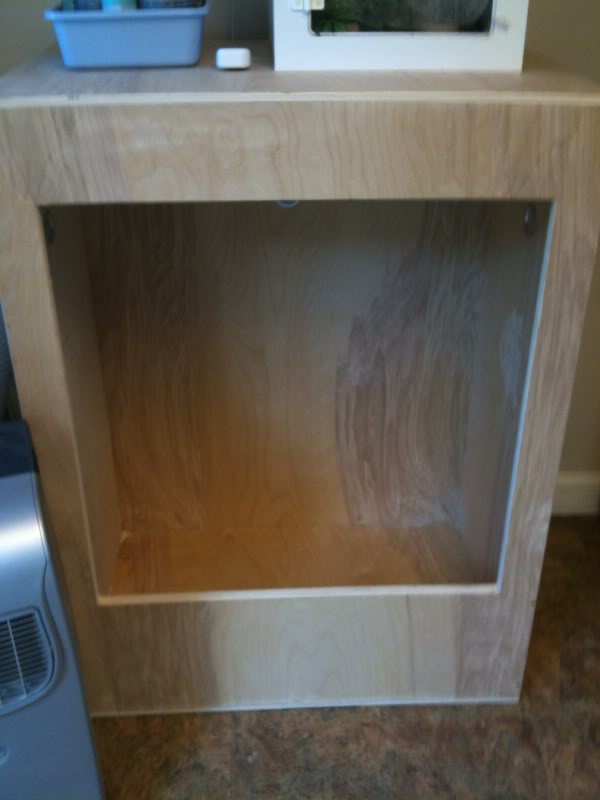
They'll be back next week..........
Last edited by Skiploder; 06-30-2010 at 11:15 AM.
-
-
Re: The Pine Debate
Does pine ACTUALLY inhibit the conversion of urine into ammonia, or does it merely mask the odor of ammonia?
-
Posting Permissions
- You may not post new threads
- You may not post replies
- You may not post attachments
- You may not edit your posts
-
Forum Rules
|








 Reply With Quote