» Site Navigation

0 members and 801 guests
No Members online
Most users ever online was 47,180, 07-16-2025 at 05:30 PM.
» Today's Birthdays
» Stats
Members: 76,067
Threads: 249,217
Posts: 2,572,782
Top Poster: JLC (31,651)
|
-
BPnet Veteran


Re: Derma balls
 Originally Posted by jkobylka

boy this thread is all over the place!!  but a few comments:
There are/have been at least 3 scaleless/partially scaleless bps in existence. I assume the are all still alive.
It think it might well have heat sensing ability still from the skin on the nose, of course it doesn't have heat "pits" because the pits are created by the scales themselves.
Justin
I think you are right on Justin. While the snake appears to be lacking the scales to make the pits I ASSUME that the snake still has heat sensing ability. A high powered flashlight might be useful in finding out if the derma in question can sense heat.
From the looks of other scaleless snakes that have been proven to be genetic the amount of missing scales can vary quite a bit.......it makes me wonder if some of the dermas will have scales to create the pits. I imagine they will but we will have to wait...(that is of course assuming that the derma does prove to be genetic).
I was only aware of two...now three....hmmm
-
-
Registered User
Re: Derma balls
as of right now i know of 3 for sure the original male. there is a female
i dont know the sex of the 3rd animals and there maybe one more
thanks jon
-
-
BPnet Veteran
Re: Derma balls
yeah it's shopped.. look at the left side of the pic. you can see the contrasting and it looks fuzzy like he messed up the layers when he was putting the pic together. look at it closely and you'll see it's not real
~Just Call Me RJ~
1.0 Kahl Line Albino Boa: Creamsicle
1.0 Sun Glow(Kahl): Logan
1.0 Poss Super hypo Poss Het T+ CA Nicaraguan Boa: Brutis
1.0 Pos Super Hypo Jungle PC Aby: Po
1.0 Pos Super Hypo Harlequin: Joker
0.1 Hypo Reverse Stripe: Harley Quinn
0.1 T+ Nicaraguan Boa: Dulce
Tru-Boaz.com
-
-
Re: Derma balls
Samurai...it's a real snake...and there's nothing wrong with the photo... lol
-
-
Re: Derma balls
Originally Posted by SamuraiZr0
yeah it's shopped.. look at the left side of the pic. you can see the contrasting and it looks fuzzy like he messed up the layers when he was putting the pic together. look at it closely and you'll see it's not real
No actually it's not. I use photoshop on a regular basis, and the difficulty and time it would take a professional to photoshop something like that is a waste. Not to mention, there would be no easy way to graft skin on it like that and the scales with matching coloration. We're talking straight days of work here, that I doubt anyone would do. You can also see the reality of the snake if you look by the tail, where the skin wrinkles. The patched scales are also completely randomized.
Sorry, I'm kinda a nut when people just assume something is 'shopped'.
-
-
Registered User
Re: Derma balls
Originally Posted by WingedWolfPsion
I can see how having no scales may make the animal more prone to scratches, but apart from that, in a captive environment...I can't see it as seriously disadvantaged. A lot depends on whether whatever caused that mutation has any other effects (the snake might be sterile--future manifestations might lack important scales such as eye caps, etc).
But the snake does have eye caps, and it eats, grows, and presumeably behaves normally. It is purportedly healthy. It doesn't even have the disadvantage that hairless mammals have, because being a reptile, it's ectothermic. While the scales provide protection from the environment, it's not as if the animal has no skin--we get by with just skin, and no fur or scales. Perhaps its skin is thin, but if it's not habitually getting scratched or cut, then it's not coming to any harm from its peculiar condition.
I've seen people saying that it has no heat pits, but it was obvious to me the first time I laid eyes on it that it does--the heat pits are shaped by the lip scales, but underneath those scales is sensitive skin--and that's what you see, just the skin, without the scales that would give the pits their shape. They still work just fine.
Obviously, as the animal has no problems eating.
All morphs are genetic mutations, and many of the carry with them potential problems, or sensitivities, that a normal animal would not have. White ball pythons would sunburn--but in captivity, they almost never see the sun. The eyesight of albinos is poor, and they may go blind if exposed to bright light or UV--but in captivity, that is unlikely to happen, and it's unlikely to prove to be a serious handicap if it does.
The derma ball would be scratched and develop infections as a result, in the wild--but it isn't in the wild, and scratches can be easily treated with a topical antibiotic ointment, and prevented by keeping it on newspaper in a cage with no sharp edges.
Apart from its bizarre appearance, what is the REAL problem with it? Where do you draw the line between a 'morph' and a deformity? If someone bred ball pythons that grew to 8 feet, which category would they be in? What if they never exceeded 3 feet? What about the oddly shaped faces of the cinnamon line? Is that a deformity, or just an interesting morph characteristic? (It doesn't seem to do the animal any harm).
I think there is a good chance that the derma ball suffers no handicap from its condition in the environment it lives in--captivity. If it's not handicapped, why consider that to be a deformity?
I've seen people talk about how many other health problems it might have--what if it has none? What if all derma balls will hatch out looking just like that one--partially scaled, but with eyecaps and all the necessary body parts, and in otherwise good health? Would opinions change?
Thank you, that is what I wanted to say as well
Last edited by mcbrayerreptiles; 10-23-2008 at 10:24 PM.
Reason: spelling
-
-
BPnet Veteran
Re: Derma balls
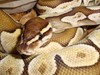
I think these "derma" balls are awesome. I had the pleasure of holding one and the texture is amazing. It gives the snake a human like quality and their faces look so cool. The color on them is so clear and sharp. If it eats, poops, and breeds fine whats the problem? True I would probably only feed pre-killed and be mindful of what I put in the enclosure. One cool thing is these guys shed very frequently compared to a similarly sized ball. Also, the amount of scalelessness (is that a word?) varies quite a bit from partially to nearly fully (just a few scales).
All you people, who have negative things to say, are jealous. Lol, flame me! 
-
-
BPnet Veteran
Re: Derma balls
Originally Posted by SamuraiZr0
yeah it's shopped.. look at the left side of the pic. you can see the contrasting and it looks fuzzy like he messed up the layers when he was putting the pic together. look at it closely and you'll see it's not real
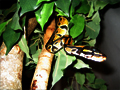
lol what a sad individual...anything you dont believe in you just assume is photoshopped? I can assure you that this is not a photoshop none of them are...there are many more pictures, but these were the ones that were close ups.
-
-
BPnet Veteran
Re: Derma balls
another pic...

-
-
BPnet Veteran

Re: Derma balls
Originally Posted by SamuraiZr0
yeah it's shopped.. look at the left side of the pic. you can see the contrasting and it looks fuzzy like he messed up the layers when he was putting the pic together. look at it closely and you'll see it's not real
Actually it is not... I have seen the animal in person at one of the shows up here on the east coast it is very real and he even let me hold it.
-
Posting Permissions
- You may not post new threads
- You may not post replies
- You may not post attachments
- You may not edit your posts
-
Forum Rules
|







 Reply With Quote