» Site Navigation

0 members and 2,160 guests
No Members online
Most users ever online was 54,199, 06-29-2026 at 02:43 AM.
» Today's Birthdays
» Stats
Members: 76,107
Threads: 249,259
Posts: 2,573,012
Top Poster: JLC (31,651)
|
-
BPnet Veteran

-
-
Re: Help with Morphs
 Originally Posted by RoyalGuardian
Ok so I have all of the different morphs pretty much recognized, but there is still something I don't get. I think I have a little normal morph BP, but if I wanted her to have pretty babies what would I have to do? Basically, are some morphs random? They are a genetic mutation so I would assume the answer to be yes but if normal morphs are in the wild where do the Spiders, Mojave, and cinnys come from?
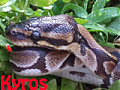
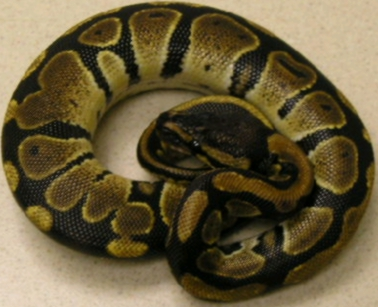
This is my little Kyna.. She is normal... Isn't she? 

Well if you want her to have pretty babies you would need to breed her to a Dominant or Co-Dominant male. Here is a good way to understand genetics a little better and give you an idea of the results you will get if one day you breed your female http://www.ballpython.ca/genetics.html
Except for designer morphs all those mutations you named as well as other like Albino, Piebald etc (Recessive gene) were first found in the wild and then imported, bred and proven to be either Dom, Co-Dom or Recessive
Yes your girl is normal
-
-
Re: Help with Morphs
no Morphs are predictable unless they are new and imported
When you've got 10,000 people trying to do the same thing, why would you want to be number 10,001? ~ Mark Cuban "for the discerning collector"
-
-
Re: Help with Morphs
Originally Posted by RoyalGuardian
Ok so I have all of the different morphs pretty much recognized, but there is still something I don't get. I think I have a little normal morph BP, but if I wanted her to have pretty babies what would I have to do? Basically, are some morphs random? They are a genetic mutation so I would assume the answer to be yes but if normal morphs are in the wild where do the Spiders, Mojave, and cinnys come from?
This is my little Kyna.. She is normal... Isn't she?
Proven Morphs have two requirements, they must be significantly different from the normal ball python and must be passed on genetically.
Initially genetic mutations arise randomly. But once they arise they can be passed on. Mutations in genes create alternative versions of genes called alleles.
Each organisms carries two copies of each gene or two alleles for each gene. (remember genes are carried along chromosomes and reptiles, like us, have two of each chromosome-one from mom, one from dad).
The different versions of a gene are expressed differently to produce a visual appearance. The relationship between the mutant allele and the normal or wild-type allele will determine the number of generations it will take to produce a genetic morph.
If the mutant allele is dominant like the spider mutation, that means you could mate your bp to a Spider BP and get some Morphs and some normals.
If its recessive it will take a little longer. If you breed an albino to a normal, you get all normal looking offspring (Aa). These normal looking offspring are special however--they carry the mutant albino allele. If you take these normal offspring and mate them to each other (Aa x Aa), you have a 25% chance for each egg being an albino. Alternatively, you could mate one of these offspring (Aa) to the original albino parent (aa) and increase you chances to 50% for each egg.
That some of the basics......There are other relationships between mutant and normal alleles.....co-dominant is one.
My recommendation--if you really want to learn it right--check out a good biology/genetics text book. Then use this site--There are a lot of people here that can help you apply it to snakes.
EDIT-->I like what you have on your website so far.
Last edited by Mendel's Balls; 01-12-2007 at 07:26 PM.
~ 1.0.0 Python regius ~ Wild-type ~
~ 1.0.0 Canis familiaris ~ Blue Italian Greyhound ~
~ 0.0.9 Danio rerio~ Wild-type and Glofish


-
-
Re: Help with Morphs
All morphs are random genetic mutations that have popped up. Most, if not all of the mutations that are in the hobby today have likely been around in wild populations for thousands of years. For a mutation to stay in the gene pool it must, first and foremost, not be fatal in and of itself (obviously  ). For those traits that are very conspicuous (i.e. albino), they stay in the gene pool through heterozygous carriers. You may have noticed that all of the dominant genes are much more subtle, as dominant mutations that are easy for predators to spot will likely not stay in the gene pool for long. ). For those traits that are very conspicuous (i.e. albino), they stay in the gene pool through heterozygous carriers. You may have noticed that all of the dominant genes are much more subtle, as dominant mutations that are easy for predators to spot will likely not stay in the gene pool for long.
As far as getting pretty babies, start with pretty adults. Most of the inherited traits are not single genes like the marketed morphs, and normal balls are quite variable in appearance (so are all animals for that matter). You can selectively breed for various traits in normals with varying success. You have a nice looking normal there, but to get drastically different looking babies, the best route is to buy a proven morph.
-Evan
-
-
Re: Help with Morphs
Originally Posted by GA_Ball_Pythons
Well if you want her to have pretty babies you would need to breed her to a Dominant or Co-Dominant male. Here is a good way to understand genetics a little better and give you an idea of the results you will get if one day you breed your female http://www.ballpython.ca/genetics.html
Except for designer morphs all those mutations you named as well as other like Albino, Piebald etc (Recessive gene) were first found in the wild and then imported, bred and proven to be either Dom, Co-Dom or Recessive
Yes your girl is normal
Wow that's a great website. Love the pix and not just words!
Pick your favorite co-dom or dom and get a male and your in business. Oh yeah and be patient, doesn't happen over night more like over years.
-
-
BPnet Veteran
Re: Help with Morphs
Sweet! Thank you for the help! My little kyna and I really appretiate it!
She may just be a Little normal, but to me she has some of the prettiest spots and colorations i have ever seen! *proud mommy*
-
-
Re: Help with Morphs
Originally Posted by Evan Jamison
All morphs are random genetic mutations that have popped up.
-Evan
All morphs are 1 or more genetic mutations that have popped up.
If you havent check these FAQs yet, you may want to http://www.ball-pythons.net/forums/s...ad.php?t=30766
You learn about "base" vs. "designer" morph.
~ 1.0.0 Python regius ~ Wild-type ~
~ 1.0.0 Canis familiaris ~ Blue Italian Greyhound ~
~ 0.0.9 Danio rerio~ Wild-type and Glofish
-
-
Re: Help with Morphs
Originally Posted by westcoastjungle
Wow that's a great website. Love the pix and not just words!
Pick your favorite co-dom or dom and get a male and your in business. Oh yeah and be patient, doesn't happen over night more like over years.
Far from being in "business" just a simple way for a beginner to start to understand some basics about BP and genetics.
It takes years of learning and breeding is more then just put 2 BP together it's a long learning process hard work and commitment.
-
Posting Permissions
- You may not post new threads
- You may not post replies
- You may not post attachments
- You may not edit your posts
-
Forum Rules
|





 Help with Morphs

 Reply With Quote