






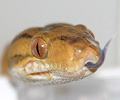
I've had plenty of experience with this whole family (Pantherophis obsoletus & their close cousins) but none that are "calico". However- normal 'black' rat snakes hatch with a pattern & gradually get darker, usually covering all or most of the pattern they start with. Now 'black' rat snakes aren't all the same & they cover a wide territory- some have underlying colors of reds or yellows that you normally never see because they're black, but then they've been crossing in for albino or amel.
I used to have & raise Amelanistic black rat snakes, & they ranged in coloration- a few were solid pale peachy or only the faintest pattern, to a cream color with moderate or bold orange or red-orange pattern (like you see on sun glow boas) because they originated with hidden red/red-orange. Since then, others are playing with other genes for white sides & calico, so if you're interested, I'd HIGHLY recommend that you ask the specific breeders to show you pics of the adults that produced the hatchlings- & bear in mind that in any given litter, they don't all turn out the same coloration or pattern- so ask them what they predict- they should have a pretty good idea. And some people are crossing things just to get something eye-catching & "different", so always ask the source if it matters to you.
I have yet to hear of any cow that would stand still for a snake to suckle with needle-sharp teeth, so I promise that "Calico cow suckers" (& all "milk snakes") are grievously mis-named, whatever their genetics.Besides that, snakes do not drink milk, no matter how many in southeast Asia try to offer saucers of milk to their admired cobras, although perhaps if there's no water, that could make a difference?

 Reply With Quote