» Site Navigation

0 members and 1,525 guests
No Members online
Most users ever online was 47,180, 07-16-2025 at 05:30 PM.
» Today's Birthdays
» Stats
Members: 76,073
Threads: 249,220
Posts: 2,572,809
Top Poster: JLC (31,651)
|
-
I have one request. If you are going to do this paper (and the larger BP industry) any justice, don't take the same path that whoever jacked up proper genetics terminology did when they first described BP mutations.
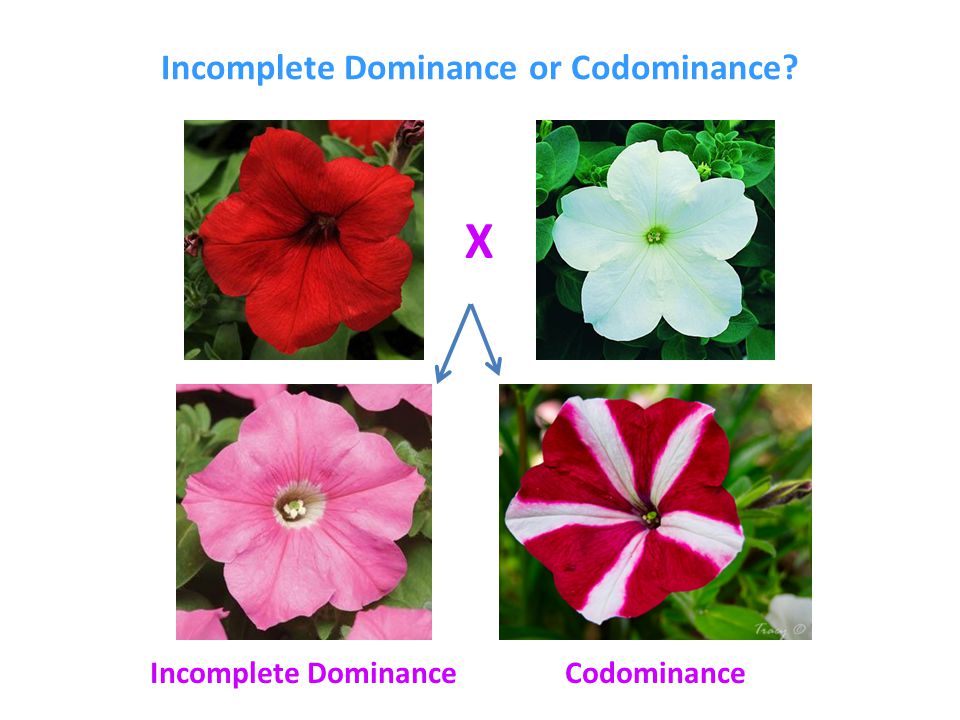
For example, use "incomplete dominant" instead of "co-dominant" when speaking about Pastel, Banana, Orange Dream, Enchi, etc. There are no known actual co-dominant mutations in ball pythons. Yet, that term is so ingrained in our hobby lingo I'm not sure it'll ever find its way out. There are other examples as well, but this one should be pretty easy to get right.
Thanks, and good luck! 
Picture of the difference between incomplete dominant and co-dominant:
Last edited by Eric Alan; 11-21-2017 at 06:27 PM.
-
The Following 4 Users Say Thank You to Eric Alan For This Useful Post:
Alicia (11-22-2017),asplundii (11-22-2017),Ax01 (11-21-2017),Family Jewels (12-07-2017)
-
Re: Ball python single gene morph descriptions -need feedback
wow you're BP vocabulary and concepts are all over the place. lemme try to help out...
 Originally Posted by cchardwick

I see you don't have a description for Asphalt. That's one morph that I find very interesting, most people would consider it co-dominant having a super form. However, even the trained eye can't tell if you have an Asphalt or a Normal.
i think a trained eye can def. tell the difference. the challenge is trying to tell the difference between an Asphalt vs. Gravel vs. Yellowbelly.
Originally Posted by cchardwick
In my mind this would be a recessive gene, the super being the recessive visual.
in your mind only. it's not recessive and there is no such thing as a het Asphalt. please don't spread misinformation (b/c u can't distinguish an Asphalt vs. Normal).
Originally Posted by cchardwick
The Gravel is similar, I think they are just different lines of the same morph, the Asphalt being discovered in Canada, the Gravel in the US.
that's actually a good theory.
Originally Posted by cchardwick
I'm pretty sure both were discovered by accident when pairing up with Yellowbelly to create the very impressive allelic Highway and Freeway complexes.
Highways and Freeways are not complexes. they are (designer) morphs part of the Yellowbelly/Super Stripe complex.
Originally Posted by cchardwick
There are several morphs that I've never heard of before, I wonder if some were named based on a single individual and then not proven genetic? (Alloy, ARP, Arctic, etc..)
Chocolate is a dark snake, super Chocolate is even darker.
Disco is a 'lightener' or enhancer, similar to Fire or Xtreme Gene. It's allelic to Fire and a Disco Fire is a white snake (in the same complex).
i'm not familar w/ Chocolate but do own Fire combo's and a (Pastel) Disco Fire. a Disco Fire is not a white snake. to put it simply, it looks like a Fire Pied w/ various degrees of whites or ringers.
Originally Posted by cchardwick
Blade is interesting... It's usually only associated with the Clown gene. I think it was originally used to describe a reduced pattern Clown. I've often wondered it it's actually Enchi. I've seen Enchi Clowns and they look exactly like a Blade Clown.
no, it's not an Enchi. Blade is it's own morph, bred and isolated from reduced BHB Clowns by EBN and Markus Jayne.
Originally Posted by cchardwick
I think 'LC Black Magic' may be multiple genes. Not sure what the LC means but a Black Magic is Black Pastel + Mojave.
LC Black Magic is a morph w/ LC being the breeder’s (combined) acronyms. Black Magic is a (designer) morph made of the base morphs u mentioned.
Originally Posted by cchardwick
Scaleless Head may not be missing any scales on the head, it may have 'micro scales'.
Scalessless and Micro-Scales are different. Micro-Scales do have missing scales on the head, but also have smaller scales overall throughout he BP body.
sorry but I think u need to hit the books harder. i'm still a noob myself but there's alotta misinformation here and i've seen u get stuff wrong in your other posts too.
RIP Mamba
----------------
Wicked ones now on IG & FB!6292
-
The Following 4 Users Say Thank You to Ax01 For This Useful Post:
Ashley96 (11-22-2017),asplundii (11-22-2017),Godzilla78 (11-23-2017),jmcrook (11-22-2017)
-
Registered User

Re: Ball python single gene morph descriptions -need feedback
Thanks again for the helpful feedback! While I agree that there is an issue with terminology being used inconsistently, even discussing with my professor it has been difficult to really determine an exact difference between "codominant" and "incomplete dominant" alleles, unless you actually know the underlying coding sequences involved. Still, in any paper we write we would probably use incomplete dominance to refer to the currently cataloged "co-dominant" mutations. However, we can only publish this work if our dataset is robust and is thoroughly verified (ie every morph we include has been confirmed in inheritance pattern and is confirmed to be distinct from other existing mutants).
-
-
Thanks for the clarifications! I'm no geneticist, just a hobbyist trying to understand it all. I think it helps to at least make an attempt to discuss these things so we can iron out the details along the way, feel free to correct any errors I make. I've only been doing this for a few years now, seems like I learn something new every day!
Last edited by cchardwick; 11-22-2017 at 11:27 AM.
-
The Following 2 Users Say Thank You to cchardwick For This Useful Post:
Ashley96 (11-22-2017),Ax01 (11-22-2017)
-
Re: Ball python single gene morph descriptions -need feedback
Originally Posted by reptilelover1995
Thanks again for the helpful feedback! While I agree that there is an issue with terminology being used inconsistently, even discussing with my professor it has been difficult to really determine an exact difference between "codominant" and "incomplete dominant" alleles, unless you actually know the underlying coding sequences involved. Still, in any paper we write we would probably use incomplete dominance to refer to the currently cataloged "co-dominant" mutations. However, we can only publish this work if our dataset is robust and is thoroughly verified (ie every morph we include has been confirmed in inheritance pattern and is confirmed to be distinct from other existing mutants).
The exact difference is clear, though. Phenotypically, there are no known co-dominant mutations in ball pythons.
As an example, when you cross a Pastel with a Spider you get a Bumblebee, which is a blend of the two mutations. This indicates phenotypical incomplete dominance. You do not get a "zebra-patterned" animal which shows areas of both individual Pastel and individual Spider pattern. That result would indicate phenotypical co-dominance. The same phenotypical blending of mutations holds true with every known mutation in ball pythons. If your professor cannot see this difference, I would be questioning their understanding of the two terms.
-
The Following User Says Thank You to Eric Alan For This Useful Post:
Family Jewels (12-07-2017)
-
Registered User
Re: Ball python single gene morph descriptions -need feedback
As far as I have understood it, an incomplete dominant allele is an allele where there is a partial expression of one allele in the heterozygote that is achieved fully in the homozygote, whereas a co-dominant allele is where the heterozygote expresses both phenotypes simultaneously (as the classic example being of red and white alleles showing a pink flower) - I had not heard of the regional partitioning as differentiating between the two, but I will try to see if there are any papers through Web of Science to back that up [if I find some, I will post the source information here]. However, like I said, I do plan on using the term incomplete dominant in any publication I write as it does more accurately fit the description of these mutants.
Also, @Ax01, you say that Asphalt is actually identifiable in the heterozygote form - what phenotypic features distinguish a heterozygote Asphalt mutant from a wildtype? Also, could you elaborate on the phenotype of the Blade mutant? I have been able to find very little information, and only have one picture of a single individual, so I cannot reliably classify it or distinguish it from certain other mutants.
Last edited by reptilelover1995; 11-22-2017 at 01:36 PM.
-
The Following User Says Thank You to reptilelover1995 For This Useful Post:
-
Registered User
Found a source, that is a bit on the older side, but here is what it says (direct quote):
"Within and between text books of genetics definitions are in consistent. Various names have been used: partial dominance, incomplete dominance, codominance, lack or absence of dominance, semidominance, mosaic dominance, intermediate dominance, imperfect dominance, and transdominance. The definitions vary from text to text and depend on interpretation of allelic function, although an allele's function is seldom known and often
must be assumed."
Source: Miller, W. J., and W. F. Hollander. 1995. Three neglected advances in classical genetics. Bioscience 45(2): 98-104.
There may certainly be other opinions out there, and I will continue searching, but right now my main task is to verify my dataset of morphs to ensure I have only included actual mutants, so I will not necessarily be focusing on the definitions of these terms.
-
The Following User Says Thank You to reptilelover1995 For This Useful Post:
-
That's fair (in regards to many sources needing to be cleaned up and also needing to assume the allele's function).
Your understanding is accurate. Incomplete dominance would be the full expression of the gene in the homozygous form. In ball pythons terms: Pastel = heterozygous, Super Pastel = homozygous; Yellow Belly = heterozygous, Ivory = homozygous, etc, etc, etc. The full expression of the genes are the "super" forms of said genes, hence the assumption that these genes are incomplete dominant.
To put it another way: In codominance, both alleles show themselves in the phenotype (blood types, for example). In incomplete dominance, an intermediate phenotype appears (the pink pigment example). Even more reason to make the incomplete dominant assumption over the codominant assumption.
Thus, your decision to use the term incomplete dominant is solid. And has been my one little point this entire time. 
Last edited by Eric Alan; 11-22-2017 at 03:10 PM.
-
-
Re: Ball python single gene morph descriptions -need feedback
Originally Posted by Eric Alan
The exact difference is clear, though. Phenotypically, there are no known co-dominant mutations in ball pythons.
As an example, when you cross a Pastel with a Spider you get a Bumblebee, which is a blend of the two mutations. This indicates phenotypical incomplete dominance. You do not get a "zebra-patterned" animal which shows areas of both individual Pastel and individual Spider pattern. That result would indicate phenotypical co-dominance. The same phenotypical blending of mutations holds true with every known mutation in ball pythons. If your professor cannot see this difference, I would be questioning their understanding of the two terms.
Bumblebee is not an example of either codominance or incomplete dominance. Two genes must be able to form a gene pair to be either. Spider and pastel are independent genes, as shown by breeding data. Bumblebee x normal produces normal, spider, pastel and bumblebee babies. If spider and pastel genes could form a gene pair, then a bumblebee x normal mating would only produce spiders and pastels.
As far as I can tell, here are the presently preferred definitions of codominant and incomplete dominant:
Codominant = the heterozygote is different from the two homozygotes because both genes contribute to the heterozygote's phenotype. Both genes produce functional products. The heterozygote's phenotype may be more or less intermediate between the phenotypes of the homozygotes, may be outside the range of the phenotypes of the homozygotes, or may show both homozygotes' phenotypes. The burmese and siamese genes in cats are codominants. Both genes produce functional products, and the heterozygote is the the tonkinese cat, which is roughly intermediate in color between burmese and siamese cats.
Incomplete dominant = the heterozygote is different from the two homozygotes. Only one gene produces a functional product, which produces the heterozygote's phenotype. The heterozygote's phenotype is generally more or less intermediate between the phenotypes of the homozygotes.
Most mutant genes have not been characterized as to whether or not they produce functional products. Some people use "codominant" as a collective term for such genes where the heterozygote is different from the two homozygotes. (The BioScience paper referenced two posts up is on the web at http://www.ringneckdove.com/Wilmer's...bioscience.htm). Others use "partial dominant" as the collective term. The pro geneticists do not seem to have settled on a collective term.
I think a case could be made that the mojave gene is codominant in the strict sense to the corresponding normal gene. Mojave ball pythons can be distinguished from both normals and super (homozygous) mojaves, and super mojaves are not pure white. The lesser gene can form a gene pair with the mojave gene, and the super lesser is pure white. If the lesser gene is nonfunctional, then it seems to me that the mojave gene's product is somewhat functional. The Russo gene is also in that set alleles; it may also be codominant to the normal gene.
Last edited by paulh; 11-22-2017 at 02:45 PM.
-
The Following User Says Thank You to paulh For This Useful Post:
-
Re: Ball python single gene morph descriptions -need feedback
Originally Posted by reptilelover1995
Also, @Ax01, you say that Asphalt is actually identifiable in the heterozygote form - what phenotypic features distinguish a heterozygote Asphalt mutant from a wildtype? Also, could you elaborate on the phenotype of the Blade mutant? I have been able to find very little information, and only have one picture of a single individual, so I cannot reliably classify it or distinguish it from certain other mutants.
lol i'm not good with technical descriptions. an Asphalt looks like a Yellowbelly which has "rich coloration, a marking on the top of the head, distinct flames coming up from the belly, a clear belly, and a checkered pattern along the edges of the belly." a Blade has normal colors and a reduced pattern. it's pattern has little dotting and with it being wider at the top and narrowing as it goes to the belly looking like propeller blades. of course there's variation between one example to the next for all BP's. i can pick them out most of the time but i'm not good w/ their descriptions lol. sorry, someone else more technical will pop by to help u out on that.
RIP Mamba
----------------
Wicked ones now on IG & FB!6292
-
Posting Permissions
- You may not post new threads
- You may not post replies
- You may not post attachments
- You may not edit your posts
-
Forum Rules
|









 Reply With Quote