» Site Navigation

0 members and 2,136 guests
No Members online
Most users ever online was 54,199, 06-29-2026 at 02:43 AM.
» Today's Birthdays
» Stats
Members: 76,107
Threads: 249,255
Posts: 2,572,993
Top Poster: JLC (31,651)
|
-
Registered User

Re: DIY Two Device Thermostat
Are the STC 1000 proportional or just on off
-
-
BPnet Veteran
Over in this part of the world we don't get herpstats and stuff like that. Pretty much all of my thermostats are wired myself like that. I like dixell from emerdon climate technologies, they are the best I've tried thus far.
-
-
Registered User

-
-
BPnet Veteran
Re: DIY Two Device Thermostat
I was just looking on amazon at these and wondered if they would work as well as a helix or hepastat.....for $20 a pop you cant go wrong!
Collection...
1.0.0 italian leatherback bearded dragon
0.1.0 sandfire bearded dragon
0.1.0 sandfire/cawley/ crimson/ volcano flame italian leatherback bearded dragon
1.1.0 bumblebee ball python
1.0.0 lemonblast ball python
0.1.0 axanthic ball python
0.1.0 vanilla pastel ball python
1.0.0 spider 100% het OG ball python
0.1.0 pastel 100% het OG ball python
0.1.0 spider 66% het pied ball python
1.0.0 normal ball python
1.0.0 lavender albino reticulated python
1.0.0 hypo hogg island boa
0.2.0 cats
1.1.0 dogs
2.0.0 kids
2.0 girfriends kids
0.1.0 girlfriend
.
-
-
Registered User
-
-
Hmmm, this might just end up being a project for the boyfriend (who has some experience wiring things).
Great writeup, thanks for sharing!
Last edited by KitaCat; 04-13-2015 at 09:14 AM.
0.2 Caramel Albino, 0.1 Caravanah, 0.1 Mojave Bumblebee, 0.1 Butter Pinstripe, 0.0.1 Normal, 1.0 Fire, 1.0 Spider, 1.0 Pastel Calico
0.1 Brazilian Rainbow Boa - Iris
1.1 Boa Constrictor Constrictor - Scarlet & Handsome Jack
1.0 Woma Python - Nigel
0.1 Corn Snake - Maisie
1.1 Red Eared Sliders - Esteban & Dolores
-
-
Re: DIY Two Device Thermostat
 Originally Posted by andyroof1979

I was just looking on amazon at these and wondered if they would work as well as a helix or hepastat.....for $20 a pop you cant go wrong!
They are nothing a like. Herpstats and helix are proportional controllers. They have no hysteresis and are very accurate probes (0.5ºC up or down) this unit is a on off unit, all of them have hysteresis. The accuracy is 2ºF up or down. Basically it is a hydrofarm controller, or zilla. They are ok for heavy enclosures where the spikes all on/off produce are regulated by the thermal mass of the set up. Comparing a proportional unit to an on/off is not reasonable.
This is an interesting unit, does anyone know the hysteresis of this? The better on/off units it is only 1ºF, some have an adjustable hysteresis. Others are quite a lot.
-
-
Registered User

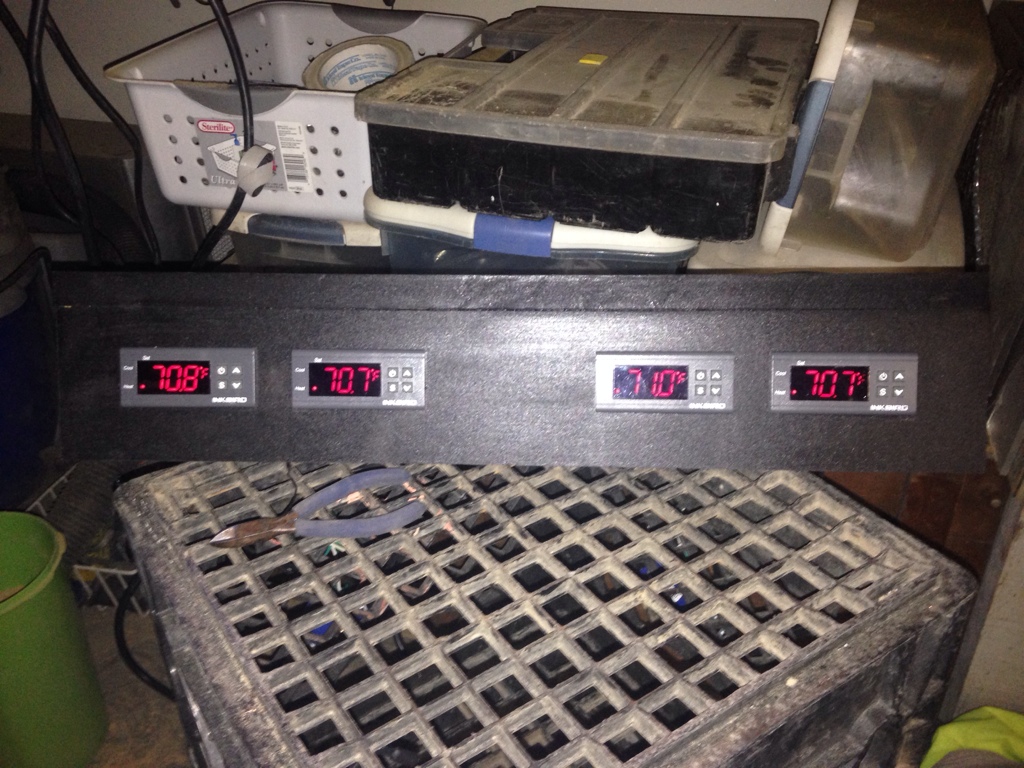
From the product info I could find online, this unit has an accuracy of +-1 F.
Adjustable hysteresis.
Alarm When Temperature Exceeds the Limit or When Sensor Error.
So probably as good, or better than the Hydropharm. (hysteresis on the Hydropharm is 2 degrees.)
And these units are only $16 US.
I may have to pick up a few of these, for some future cage builds I have planned.
-
-
interesting, after reading your post I did some looking too. I found specs on both the 'ink bird' and STC-1000 from what I saw they both have an accuracy of +/-1ºC (+/-2ºF) that is close to a 4º spread. IMO too much for plastic tubs, marginal for a PVCx but perfect for glass.
The Inkbird has an impressive hysteresis 0.1ºC so that would minimize the spikes IF the probe response is fast enough and doesn't do some odd behaviour coupled with the relatively slow sample rate (0.5s, the herpstat is 0.02s I think 60 samples per second)
The STD-1000 also seems to have good hysteresis (difference set) 0.3ºC. They didn't spec the sample times I can find. The probe response time is not in either specs typical it is too variable depending on the manufacturing process.
Are the probes of both units heavy or light?
one of the big issues with hydrofarms are the heavy probe the slow sample rates and in the old units the huge hysteresis, (2ºC!!!) They are IMO ONLY good as a back up nothing else.
I personally would not suggest one for a primary on anything but glass myself but they are certainly better than most of the reptile specific crap on/off units out there.
I am interested in them as a fail safes, i have been using hydrofarms but these look better and could be stacked easily. Where did you find the "InkBird" units?
http://www.tradeger.co.za/pdf/stc100...ing_manual.pdf
http://www.ink-bird.com/product/deta..._ITC-1000/id/6 (download manual)
-
-
Registered User
-
The Following User Says Thank You to Cumminsman For This Useful Post:
Posting Permissions
- You may not post new threads
- You may not post replies
- You may not post attachments
- You may not edit your posts
-
Forum Rules
|





 Reply With Quote
 2.0 Royals