» Site Navigation

0 members and 2,055 guests
No Members online
Most users ever online was 54,199, 06-29-2026 at 02:43 AM.
» Today's Birthdays
» Stats
Members: 76,105
Threads: 249,255
Posts: 2,572,989
Top Poster: JLC (31,651)
|
-
How do you get a 3 gene animal?
I was wondering how people produce Albino Enchi Pinstripes. Each of the animals has one gene and you have two parents so how do you get a three gene animal?
thanks
0.1 Black & White Argentine Tegu
2.0 Yellow Ackies
-
-
Registered User

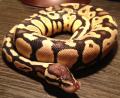
Albino + Enchi het. Albino = Albino Enchi
Albino Enchi + Pinstripe het Albino. = Albino Enchi Pinstripe
There are multiple ways to get that 3 gene animal. This is just one example.
1.0 Mojave
0.1 Pastel
1.0 Bumble Belly
-
The Following User Says Thank You to Commandokev For This Useful Post:
monty_python9 (10-12-2014)
-
It depends on which genes are involve. One example would be a dominate gene such as a Spider bred to a Co dom gene Pastel. In this case both genes have the chance to be visual in the offspring, a Bumble Bee. A Bumble Bee having both genes, Spider and Pastel would be carrying both visual genes. If you bred a Bumble Bee to another visual gene such as a co dom Enchi, you would have a chance to combine the three genes together and produce a 3 gene animal, such as a Stinging Bumble Bee.
When you involve recessive traits, it gets a little bit tricky because those traits are not expressed as easy.
-
The Following User Says Thank You to WmHrbst For This Useful Post:
monty_python9 (10-12-2014)
-
Re: How do you get a 3 gene animal?
 Originally Posted by monty_python9

I was wondering how people produce Albino Enchi Pinstripes. Each of the animals has one gene and you have two parents so how do you get a three gene animal?
thanks
It's basically simple math when talking about dominant/incomplete dominant genes. There are a few different ways to add to get to the number three, and any of the ways you do it is perfectly fine:
0+3=3
1+2=3
2+1=3
3+0=3
The same basic principle works in genetics, where each number you're adding together is equal to the number of genes in each parent snake (left side of equation=male, right side=female, total=offspring). Of course, in genetics, if you add (pair) any two numbers (snakes) where their sum (total combined genes) is greater than or equal to three, you could also end up with three (three genes).
Now, each of your animals only has one gene to bring to the table. You can't combine any of them together in one shot to end up with a three gene offspring.
Like WmHrbst already said - recessive genetics are a little different story, but they still follow the same basic math principle at the ground level.
-
The Following User Says Thank You to Eric Alan For This Useful Post:
monty_python9 (10-12-2014)
-
Re: How do you get a 3 gene animal?
Originally Posted by monty_python9
I was wondering how people produce Albino Enchi Pinstripes. Each of the animals has one gene and you have two parents so how do you get a three gene animal?
thanks
Any breeding project is approached the same way:
1. Determine the the genotype of the end product.
2. Determine the possible genotypes of the parents.
3. Repeat step 2 for the grandparents, great grandparents, etc. until reaching a generation where each individual has only one gene pair containing mutant genes.
End product: An enchi pinstripe albino
1. An enchi pinstripe albino has a minimum of 3 gene pairs with mutant genes.
Gene pair 1 = an enchi mutant gene and a normal gene
Gene pair 2 = a pinstripe mutant gene and a normal gene
Gene pair 3 = 2 albino mutant genes
One gene in each gene pair comes from the father, and the other gene in each gene pair comes from the mother.
2. At least one parent has at least one copy of the enchi mutant gene. At least one parent has at least one copy of the pinstripe mutant gene. Both parents have at least one copy of the albino mutant gene. Possibilities: one parent is either enchi albino or enchi het albino. The other parent is either pinstripe albino or pinstripe het albino.
3. Enchi mated to albino produces
1/2 enchi het albino
1/2 normal-looking het albino
Pinstripe mated to albino produces
1/2 pinstripe het albino
1/2 normal-looking het albino
You have
0.1 Albino
0.1 Enchi
1.0 Normal
1.0 Pinstripe
I would suggest getting a male albino to mate with your enchi female. A male het albino would also do, but the enchi babies would be only enchi possible het albinos. Then the best idea is to keep all the female enchi possible het albinos to mate with one or more pinstripe het albino males.
By the way, each egg from an enchi het albino x pinstripe het albino mating has a probability of 1/16 (6.25%) of having an enchi pinstripe albino hatch from it. Probability of an enchi pinstripe albino increases if one or both parents is albino instead of het albino. Depending on cost, it may be worthwhile looking for an enchi albino or pinstripe albino for one parent.
-
-
Re: How do you get a 3 gene animal?
Ill give you the basic english explanation. I know all this talk of genotypes and odds can be confusing.
Bps can carry more than 1 gene at a time. In your explanation you mentioned 2 one gene snakes. To get a 3 gene snake you need at least one of them to be 2 gene.
Example:
Pastel mojave male
Breed with
Pinstripe female
You have a chance at getting a baby snake that has all 3 genes:
Mojave pastel pinstripe.
Each gene will have a 50/50 chance to be transferred to the baby.
-
-
Re: How do you get a 3 gene animal?
Originally Posted by Izzys Keeper
Ill give you the basic english explanation. I know all this talk of genotypes and odds can be confusing.
Bps can carry more than 1 gene at a time. In your explanation you mentioned 2 one gene snakes. To get a 3 gene snake you need at least one of them to be 2 gene.
Example:
Pastel mojave male
Breed with
Pinstripe female
You have a chance at getting a baby snake that has all 3 genes:
Mojave pastel pinstripe.
Each gene will have a 50/50 chance to be transferred to the baby.
With albinos its basically the same idea, but both parents need to have a copy of the albino gene somewhere in them to produce a visual albino. And that means a 50/50 shot for each parent to transfer that to the baby
-
-
Re: How do you get a 3 gene animal?
Originally Posted by Izzys Keeper
... Bps can carry more than 1 gene at a time. ....
This is because it takes many thousands of genes to build a ball python. All ball pythons have the same number of genes. A "one gene" snake has an error in one gene. A "two gene" snake has an error in two different genes. A "three gene" snake has an error in three different genes. And so on. For simplicity, we ignore the huge number of genes that are error-free.
Last edited by paulh; 10-13-2014 at 02:15 AM.
-
Posting Permissions
- You may not post new threads
- You may not post replies
- You may not post attachments
- You may not edit your posts
-
Forum Rules
|






 Reply With Quote