» Site Navigation

0 members and 1,825 guests
No Members online
Most users ever online was 47,180, 07-16-2025 at 05:30 PM.
» Today's Birthdays
» Stats
Members: 76,073
Threads: 249,220
Posts: 2,572,811
Top Poster: JLC (31,651)
|
-
10-09-2013, 02:04 AM
#111
Re: Fellow dog owners - what food do you feed?
Sorraia, I think I love you!
My dog gets prey-model raw. Prior to that I was feeding a mix of raw and pre-made raw, Nature's Variety Instinct frozen raw diet. Waaaay back when we were doing kibble I fed a mix of Acana and raw. You should be careful if you mix raw and kibble to feed them separately, as they digest very differently. Will it kill them not to? No, but it's easier on their digestive system. I personally did kibble in the morning and some raw chicken at night as the bones help clean their teeth.
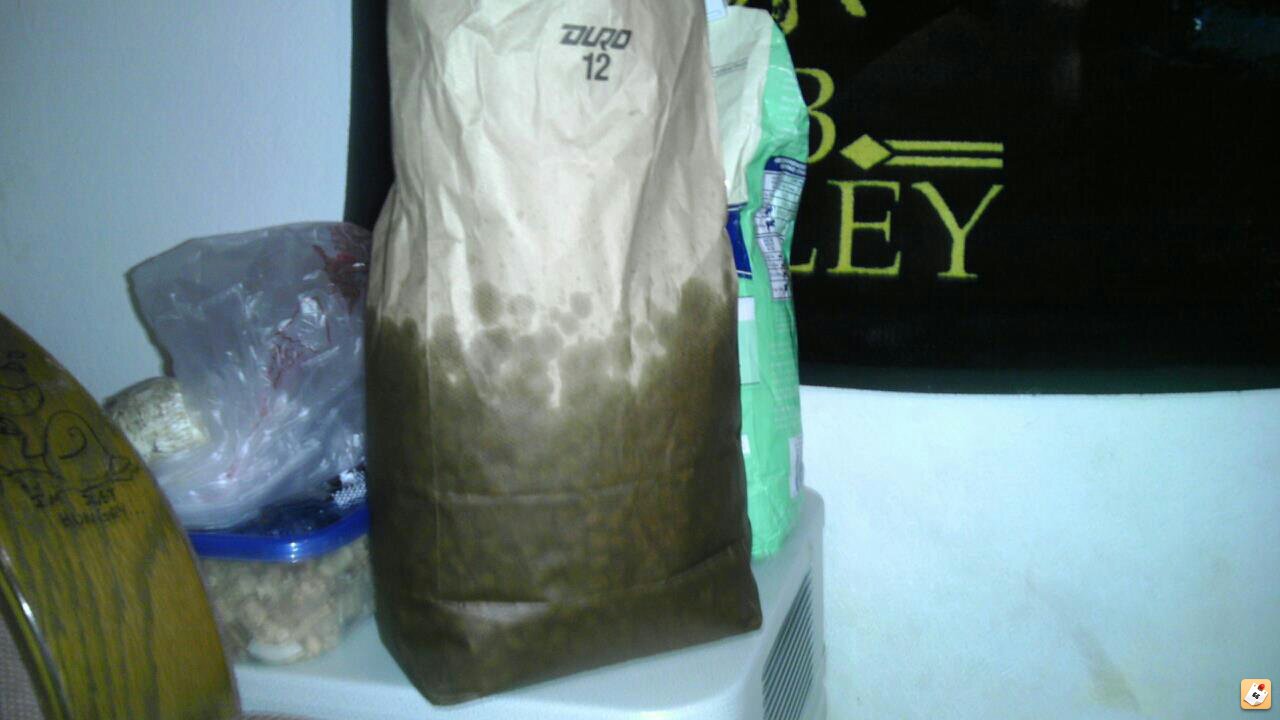
I'd also like to show everyone this picture. When we adopted our dog, the humane society gave us a bag of Science Diet since that's what they fed. Does this LOOK healthy?? That was from a couple hours of sitting around, it left a grease puddle under the bag. I threw it away and switched him cold turkey, screw that.
Sent from microwave using Tapatalk 2
Last edited by Coleslaw007; 10-09-2013 at 02:04 AM.
Balls:
*0.1 Mojave *0.1 Pinstripe *0.1 Bumblebee *1.0 Super pastel butter *1.0 Mojave orange ghost *0.3 100% het orange ghosts *0.1 Pastel 50% het orange ghost *1.1 PE Lemonback fires *1.0 Fire *0.1 Pastel *1.0 Albino *0.1 Spider 100% het albino
Other critters:
*1.0 Anery motley corn *G. rosea tarantula *G. pulchripes *P. metallica *0.0.2 A. versicolor *C. cyaneopubescens *A. geniculata *B. smithi *B. boehmei *Nhandu chromatus *H. maculata *C. marshalli *1.0 Australian shepherd mix
-
The Following 2 Users Say Thank You to Coleslaw007 For This Useful Post:
AlexisFitzy (10-09-2013),Mike41793 (10-09-2013)
-
10-09-2013, 03:08 AM
#112
BPnet Veteran



Damn you raw feeders and your shiny coat dogs, lol, I need to find a decent supplier so I can get my pups off this kibble already.
Last edited by Aztec4mia; 10-09-2013 at 03:09 AM.
Reason: spelling
-
The Following 2 Users Say Thank You to Aztec4mia For This Useful Post:
bad-one (10-09-2013),satomi325 (10-09-2013)
-
10-09-2013, 03:16 AM
#113
Re: Fellow dog owners - what food do you feed?
 Originally Posted by Coleslaw007

Sent from microwave using Tapatalk 2
I was not aware that Five Guys started selling dog food. 
Lucifer Sam, Siam cat...
Always sitting by your side,
Always by your side...
That cat's something I can't explain...
-
The Following 2 Users Say Thank You to sho220 For This Useful Post:
Coleslaw007 (10-09-2013),Mike41793 (10-09-2013)
-
10-09-2013, 03:37 AM
#114
I've fed both Wellness and Blue to our dogs. Both are great foods and that keep our bullies looking great but awful expensive for four dogs lol (although blue wilderness has given my brindle pup the runs, must be the high protein content)
We are now switching to Kirkland lamb recipe for our pups. I've seen some mixed reviews due to recalls but I have some fellow groomer/trainer friends who swear by it. Since I've started mixing it 50/50 with Bear's meals his diarrhea is going away ( no more stinky bully farts!). For being almost a 1/4 of the price of high end brands it is still miles above many foods!
Brittany Davis
0.1 Snow BCI- Isis
1.0 Hypo Motley het Albino BCI- Rupert
Ball pythons
1.0 Champagne, 1.0 Albino Spider, 1.0 Savannah, 0.2 Normal, 0.1 Het Toffee, 0.1 Black Butter,
0.1 Spider, 0.2 Pastel, 0.1 Enchi, 0.1 Albino
-
The Following User Says Thank You to bad-one For This Useful Post:
-
10-09-2013, 09:02 AM
#115
Re: Fellow dog owners - what food do you feed?
Originally Posted by Aztec4mia
Damn you raw feeders and your shiny coat dogs, lol, I need to find a decent supplier so I can get my pups off this kibble already.
I completely agree, I've been considering a raw diet for a while and just have gotten around to doing enough research to feel comfortable preparing meals and finding a supplier.
-
-
10-09-2013, 09:14 AM
#116
Did raw for a while and never saw a noticeable difference. The whole food allergy thing is blown out of proportion - a good friend is actually a dog allergy specialist and he has told us that food items represent a very low percentage of canine allergies.
Ouir old staffy bull did fine on kibble (16.5 years when he died). Before that our tibetan mastiff did well on kibble (14 years).
Our current dogs do fine on grain free kibble. Again, did the raw thing, did it for a while and never noticed good or bad changes.
My take is this: dogs are not wolves, they are dogs. Dogs are carnivores, they are pack animals and they are canids - but they are not wolves. Recent genome-wide analyses of dogs and wolves revealed that dogs have more copies of a gene that allows dogs to produce amylase, which is used in the digestion of starches. Wolves have only two copies, domestic dogs have anywhere from four to thirty.
I am not against feeding raw - what I am against is people who feed raw and adopt superior attitudes because they do it.
Last edited by Skiploder; 10-09-2013 at 09:23 AM.
-
The Following 7 Users Say Thank You to Skiploder For This Useful Post:
AlexisFitzy (10-09-2013),Anya (10-09-2013),bad-one (10-15-2013),Coleslaw007 (10-09-2013),cristacake (04-19-2016),Mephibosheth1 (10-09-2013),sorraia (10-09-2013)
-
10-09-2013, 10:11 AM
#117
Re: Fellow dog owners - what food do you feed?
Originally Posted by Skiploder
Did raw for a while and never saw a noticeable difference. The whole food allergy thing is blown out of proportion - a good friend is actually a dog allergy specialist and he has told us that food items represent a very low percentage of canine allergies.
Ouir old staffy bull did fine on kibble (16.5 years when he died). Before that our tibetan mastiff did well on kibble (14 years).
Our current dogs do fine on grain free kibble. Again, did the raw thing, did it for a while and never noticed good or bad changes.
My take is this: dogs are not wolves, they are dogs. Dogs are carnivores, they are pack animals and they are canids - but they are not wolves. Recent genome-wide analyses of dogs and wolves revealed that dogs have more copies of a gene that allows dogs to produce amylase, which is used in the digestion of starches. Wolves have only two copies, domestic dogs have anywhere from four to thirty.
I am not against feeding raw - what I am against is people who feed raw and adopt superior attitudes because they do it.
On that amylase thing - the presence of more genes in the dog that produces amylase does not mean the dogs are efficient carb consumers. It just means they are better than wolves at it.
Yes, environmental allergies are a lot more common than food allergies. But I have 2 English Bulldogs. Food allergies are very prominent in English Bulldogs as well as environmental allergies. Yeast blooms are also common. Tons of EB owners feed kibble. But, in the EB group I belong to, you will see quite clearly how EBs on low quality kibble suffer. But even high quality kibble doesn't just work. You have to jump around different kibble formulations to find one that would work for the dog. I just got tired of that crap so I went all raw.
Now, this is very anecdotal, but one of my EBs is allergic to chicken. Or so I thought. We went through rounds of kibble formulations on an elimination process to find one that works for him and every single kibble we tried that had chicken in it fails. Oh, and about that grain-free thing... that doesn't quite work out either. I thought, grain-free=low carb. Not so. Potatoes are high carbs too. What we did find is low protein = high carb, so we went with formula that has carbs lower than 45% (they don't list that in the bag, by the way - you have to figure it out!). Carbs on my dogs = yeast infection. We finally found Earthborn Holistics Primitive Natural that worked until Earthborn changed the formulation.
So, we went raw. I figured, if I am competent enough to feed my kids, I am competent enough to feed my dogs. My kids go to a holistic pediatrician and holistic pediatricians are very particular about nutrition so I already got quite a good grasp of human nutrition. So I fed my EB raw chicken to try it out and he was just completely fine with it. That threw me off my rocker, I tell ya.
Since I rescued these EBs, I've spent too much money on vet bills. Since I put them on raw, I've only had to take them for their physicals. That's it.
I don't have a superior attitude with raw. It is not easy to feed dogs raw. Lots of research has to be put in it and you have to really know your dog very very well because you have to tweak the diet depending on your dog's response to it. So you also have to read and read and read all about nutrition.
But what having EBs did teach me... I feel so much better about my decision to take our kids to a holistic pediatrician (yes, she is an MD) even if she did not take health insurance. My sister who is a nurse accused me of child abuse when I did that because she did not prescribe antibiotics for my kid's ear infection. Instead she gave me willow/garlic ear drops and a meal plan!
Last edited by anatess; 10-09-2013 at 10:14 AM.
----------------------------------
BP owner since Oct 2008, so yeah, I'm no expert.
0.1.0 pastel bp
1.0.0 spider bp
0.1.0 albino bp
1.0.0 bumblebee bp
1.0.0 yellowbelly bp
0.0.1 normal bp
1.0.0 normal western hognose
Life should NOT be a journey to the grave with the intention of arriving safely in an attractive and well preserved body, but rather to skid in sideways, chocolate in one hand, body thoroughly used up, totally worn out and screaming "WOO HOO what a ride!"
-
The Following User Says Thank You to anatess For This Useful Post:
-
10-09-2013, 10:25 AM
#118
Re: Fellow dog owners - what food do you feed?
Originally Posted by Mephibosheth1
I do point out with the above that, as you mentioned, there is still a lot we do not know about nutrition. Myself included. The facts are presented beautifully in your write up; I would argue about the omnivore classification, as we (who are omnivores) also lack a chambered stomach and an enlarged cecum (our cecum is actually our appendix). But I won't, as I respect the information as coming from someone who is knowledgeable in the field.
I am leaving the discussion until I have something more meaningful to add; have fun!!
Note: I'm not arguing... I just love a good discussion, and this is one subject I find fascinating. 
Yes we don't have a chambered stomach (I'm not actually aware of any omnivores that do), and our caecum is not enlarged as it is in say... a rat, but there are other differences to look at. Our stomach isn't as large as a carnivore or even some other omnivores... but in dogs it is larger and capable of holding large meals. To meet metabolic needs, we are best suited for eating small meals throughout the day (similar to an herbivore who must also eat often, but different in that herbivores tend to eat on a fairly constant basis). But this differs from a carnivore (and dogs) in that a carnivore can get away with eating one large meal and subsisting off that for a few days. Our entire digestive system is a little longer than that of a dog (proportionately speaking), because plant matter (which as omnivores we eat more of than carnivores) takes longer to digest. We've got a few more digestive enzymes than a dog that helps us to digest plant matter. I'd have to look it up to be sure, but we might possibly even have more gut microbes than a dog too (which also help us to digest plant material).
Again, dogs aren't strict, obligate carnivores as felines are. But they aren't truly omnivorous either, like bears, raccoons, pigs, or humans. Just for curiosities sake, I pulled up pictures of skulls just to compare dentition (although again, dentition is only one small piece of the overall picture), unfortunately having to rely on the Internet since all of my skulls are packed away except for the cat skull sitting on my desk... There are striking differences between different species and eating habits. These differences in dentition show not only the differences between carnivores, omnivores, and herbivores, but also the differences in specific fashions in eating. Cats have greatly reduced molars, and very sharp premolars, almost no flat surfaces at all. Dogs also have many sharp points, but their molars are a bit larger than that of a cat's, and their premolars do have some flatter (though not truly flat) surfaces. This shows the differences in eating habits: Cats tend to eat more meat and organ, and swallow bones almost whole, they shear and shred their food, they don't grind it. Dogs on the other hand eat meat and organ, but they'll also chew on larger bones to pull off the last bits of meat. They'll eat some plant matter. They don't grind food either, but they crush as well as shear and shred. Bone chewing uses premolars, not canines and incisors (any raw feeder that offers bone will see this, it's kind of fascinating to watch really). Bear on the other hand... they have larger and flatter molars. Even polar bears (who are pretty much purely carnivorous) have some flatter surfaces on their molars. This shows an ability to actually grind food, not just crush, shear, and shred. And actually, pigs and bears aren't doing nearly as much shredding and shearing as a dog or cat. Same thing seen in the dentition of a pig, and even a raccoon (although to a lesser extent in a raccoon... they tend to be a little more carnivorous, and when they do eat plant matter they are generally consuming softer plant parts, such as fruits).
Now looking at different canine skulls, you see differences too. Wolves are more carnivorous than coyotes, where a dog's dietary habits tend more toward that of a coyote. Foxes on the other hand, are more omnivorous than any of those. When you examine the dentition of wolves, coyotes, dogs, and foxes, dogs and coyotes are most similar to each other, while also resembling wolves, while foxes are the least similar. Proportionately speaking, the molars on a fox are actually a little bit larger than that on a dog (especially the last molar), and appear just a little bit flatter.
It's just all very interesting. Posting this for the sake of anyone interested. 
Canine skulls:
http://www.sdnhm.org/archive/researc.../nwcanids.html
http://www.skullsite.co.uk/Redfox/redfox.htm
http://www.skullsite.co.uk/Greenland/greenland.htm
Bear skulls:
http://www.grizzlybay.org/LearnMore/...ybearteeth.htm
http://www.skullsunlimited.com/recor...nt.php?id=3452
Pig skulls:
http://anthropology.net/2007/09/04/a...ory/pig-skull/
http://www.skullsite.co.uk/Pig/pigdom.htm
Raccoon skulls:
http://www.istockphoto.com/stock-pho...coon-skull.php
http://cyborgsuzystock.deviantart.co...skull-35331866
Why keep a snake? Why keep any animal? Because you enjoy the animal, find something beautiful and fascinating about it, and it fits seamlessly into your lifestyle.
-
The Following 4 Users Say Thank You to sorraia For This Useful Post:
Anya (10-09-2013),Coleslaw007 (10-09-2013),Mephibosheth1 (10-09-2013),satomi325 (10-09-2013)
-
10-09-2013, 10:33 AM
#119
I don't have cats as I'm allergic to them. But, I'm always wondering how cats survive off kibble?
----------------------------------
BP owner since Oct 2008, so yeah, I'm no expert.
0.1.0 pastel bp
1.0.0 spider bp
0.1.0 albino bp
1.0.0 bumblebee bp
1.0.0 yellowbelly bp
0.0.1 normal bp
1.0.0 normal western hognose
Life should NOT be a journey to the grave with the intention of arriving safely in an attractive and well preserved body, but rather to skid in sideways, chocolate in one hand, body thoroughly used up, totally worn out and screaming "WOO HOO what a ride!"
-
The Following User Says Thank You to anatess For This Useful Post:
-
10-09-2013, 10:53 AM
#120
Registered User
Re: Fellow dog owners - what food do you feed?
Originally Posted by missriss2012
Hello fellow dog owners! As the time for bringing home my puppy draws near I've been researching what food to feed my corgi puppy.
What do you feed?
Surely I'm not the only one who is wanting to feed the highest quality food possible.
Sent from my iPhone using Tapatalk - now Free
OK I hope you have found your answer among the 12 pages LOL
-
The Following 2 Users Say Thank You to Monty the BP For This Useful Post:
AlexisFitzy (10-09-2013),sorraia (10-09-2013)
Posting Permissions
- You may not post new threads
- You may not post replies
- You may not post attachments
- You may not edit your posts
-
Forum Rules
|








 Reply With Quote