» Site Navigation

0 members and 2,241 guests
No Members online
Most users ever online was 54,199, 06-29-2026 at 02:43 AM.
» Today's Birthdays
» Stats
Members: 76,111
Threads: 249,262
Posts: 2,573,028
Top Poster: JLC (31,651)
|
-
Registered User

Just for smiles
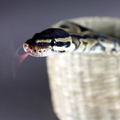
This evening I watched my friend's severely autistic son for a few hours. After my own kid finished his homework, I got out my extremely mellow 14 mo bp. He was very excited to see her again, wanted "snake kisses" like my son gets when she sniffs his nose and was thrilled to have her in his lap and on his shoulders. He's very gentle with animals, but just can't quite remember that he shouldn't reach for her head. Millie put up with all of it with extremely good grace and didn't even pull her head away when he forgot and tried to pet her head. (I intercepted. This was all very closely supervised and with his mom's permission.)
He announced several times that "Millie loves me!" I won't put up a picture of someone else's child, so you'll just have to imagine the huge grin on his face.
Even if snakes can't bond with humans, we sure can bond with them.
(Btw, I tried, but have given up on stopping my son from doing "snake kisses", and just make sure he knows not to stick his face at any other animal.)
My family:
1.0 spouse
1.0 child
0.1 Normal BP "Millie"
1.0 East African Sand Boa "Leto"
My blog:
www.AllergicKid.com

-
The Following 2 Users Say Thank You to Libby For This Useful Post:
Anya (10-02-2013),decensored (10-02-2013)
-
Registered User
Very cool. My oldest son has a mild form of autism and doesn't interact very "normal" socially. So it is pretty cool when you can witness them bonding with just about anything.
Last edited by Borgy76; 10-01-2013 at 11:02 PM.
-
-
Very heartwarming story. I can totally imagine the look on his face. I'm a firm believer in animal therapy 
-
-
That's an awesome story!!! Thank you for sharing!! 
-
-
for autists, animals are often much easier to understand than humans.
reptiles are especially predictable, with clear behavioral patterns. easy to figure out, and then they become familiar, much easier than, for example, a stranger.
i would, depending on age, go one step further and not stop him next time he wants to touch the head of the snake. if he is over 6 or 7 years old, and knows the snake, he may have figured out how the snake reacts when it bumps into something with its head, especially when it bumps into an arm or your chest when holding it. and maybe you should show him a feeding to give him a more complete image.
autists have very different minds from common people, much of what we assume is the right thing to do in order to protect them is incorrect. If autistic children are inquisitive, it should be allowed unless there is a real danger to the health. If a small campfire attracts their attention, let them inquire, a burn will cause less damage than the potential damage of denying them the experience of getting close to a campfire.
and such a subadult BP is harmless compared to a campfire, even if it does bite. i guess the autistic boy, even if he touches the head of the snake, would be unlikely to let it come close to his face, im guesstimating but it seems unlikely.
BTW i know a bit or two about this, i have a very mild form of autism, mild aspergers syndrome, and i know others that have it and so i had reasons to study autism, aspergers, high-functioning autism, and savant syndrome over the years. The main difference between autism and high-functioning autism is that some manage to find a motivation and a way to interact meaningfully with the world. those that find a way are then high-functioning autists, the rest stay just autists.
one nice example of an autist developing into a high-functioning autism, then developing a deep love and understanding of animals, and then going on to live a wildly successful life would be Temple Grandin. Others find their love for mathematics, science, music, literature/linguistics/journalism, or programming.
Dont see it as a disease. among the less common symptoms are: photographic memory, or total recall of text, or extraordinary pattern recognition. its a mixed bag of strength and weaknesses, and a few autists develop extraordinary abilities.
-
-
watch 10 minutes of this, in the following way:
skip to minute 5, thats all the introduction, start watching when Temple Grandin starts talking, and then watch until minute 15.
that will really help understanding autism, as will the rest of the talk, but these first 10 minutes will already help a lot
http://www.youtube.com/watch?v=2wt1IY3ffoU have fun
-
-
That did make me smile, thank you.
-Devon
0.1 Axanthic Bee (Pixel)
0.2 Axanthic Pastel (Cornelia, Short Round)
0.1 Axanthic (Bubbles)
0.1 Bee het Axanthic (Nipper)
0.1 Lesser (Lydia)
0.1 het Lavender (Poppy)
0.1 het Hypo (Cookie)
1.0 Killerbee het Axanthic (Yellow Dude)
1.0 Pied (Starry Starry Dude)
1.0 Butter Hypo (Spooky Dude)
1.0 PH Lavender (Little Dude)
-
-
awesome story
Like croc hunter said, we touch these animals so they can touch people, and looks like your Millie has really touched your friend's heart.
Keep up the great work
- - - Updated - - -
awesome story
Like croc hunter said, we touch these animals so they can touch people, and looks like your Millie has really touched your friend's heart.
Keep up the great work
CRYSTAL MEPH
1.0 100% Het for Carmel Normal–Mycroft (P. regius)
1.2 Manx, Scottish Fold, Tabby–Mocha, Precious, Kitty-Beau (F. domesticus)
30.90 Breeder Mice (M. musculus)
"It will all be okay in the end. If it's not okay, its not the end"
–John Lennon//oo\\
-
The Following User Says Thank You to Mephibosheth1 For This Useful Post:
Posting Permissions
- You may not post new threads
- You may not post replies
- You may not post attachments
- You may not edit your posts
-
Forum Rules
|





 Reply With Quote