» Site Navigation

0 members and 1,869 guests
No Members online
Most users ever online was 54,199, 06-29-2026 at 02:43 AM.
» Today's Birthdays
» Stats
Members: 76,104
Threads: 249,251
Posts: 2,572,972
Top Poster: JLC (31,651)
|
-
Registered User

Intro to my Hoggies
I've had my female for two years now, I figure she's your run of the mill "normal" Western Hognose. I got her for myself as a birthday present when she was a wee hatchling. I like to call her my "Birthday Snake"
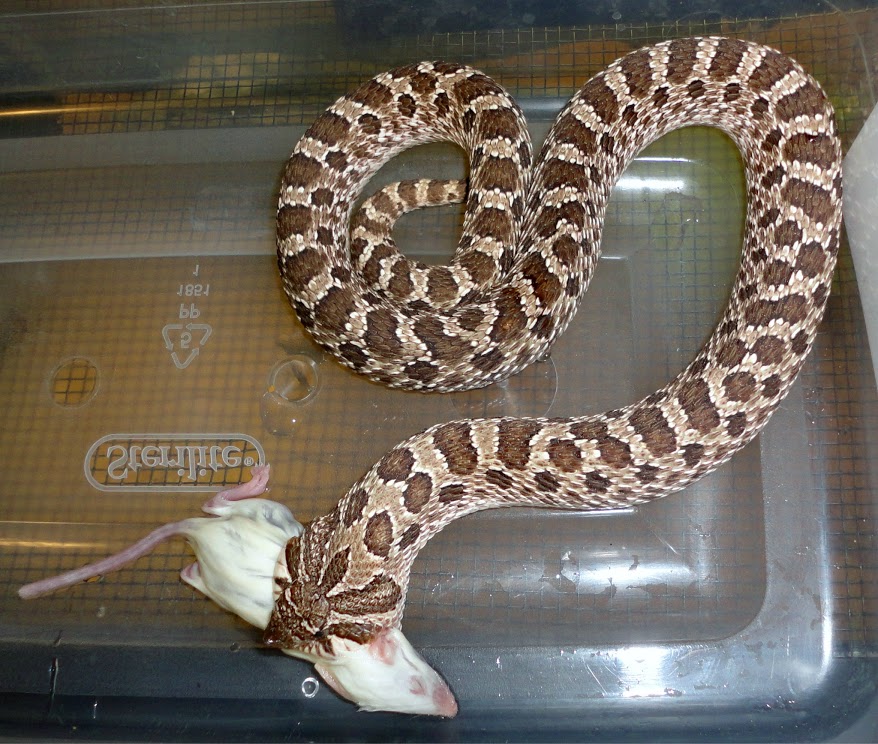
A few weeks ago, I picked up this pretty male for her, and he is much lighter in coloration. I was wondering if anyone knew anything about that? (Btw, they are both on aspen shavings, this was the first thing I put him in when I got him home.)

Here they are side by side for color comparison:

He was too pretty to pass up! Only problem is, he hasn't eaten for me as of yet. I've had him for about two weeks now, so maybe he's just stressed from the show. He's a pretty large male, and I was assured he eats well on f/t mouse hoppers. I'm not super concerned YET, but I always get a little nervous when a new acquisition refuses to eat..
Hello, all you hoggie enthusiasts!
-
-
I'm not very familiar with western hognose morphs and such but he sure is pretty! Expecting my first western next week, can't wait!
-
-
Registered User
Both are very pretty, but I would look more into that lighter colored one it might be something neat.
-
-
So cute 
---------
0.1 Dog (Truffles)
0.1 Naked Cat (Mercedes)
1.0 Hamster (Pumpkin)
1.1 Bumblebees (Satyana & Weedle)
0.3 Normals (Shayla, Rita and Althea)
0.1 100% Het Pied Ringer (Avalon)
1.0 Pied (Monsieur Piederoff)
1.0 Lesser 100% Het Albino poss het OG (Tinersons)
0.1 Spider Albino (Ivy)
0.1 Mojave Cinnamon (Morticia)
1.1 Normal BCIs (Damon and Conga)
0.1 Crested Gecko (Natasha)
0.0.1 Rosehair Tarantula (Charlotte)
0.0.1 P.Metallica
0.0.1 A.Avicularia
0.0.2 P.Irminia
0.0.1 L.Parahybona
0.0.1 N.Coloratovillosus
?.?.? ASFs 
-
-
Re: Intro to my Hoggies
Nice hogs!
Firstly, if you can get a good belly shot of the male, and a nice shot of the eye, I should be able to tell you if anything fantastical is going on with him, or if he is just a lighter color phase. Normal hogs are quite variable in color and pattern so I wouldn't be surprised if he was just a cool looking normal.
As for his eating, what is his behavior like when you offer food to him? I've had them go up to 3 months with no food (not in brumation) before so he is nowhere near being in danger yet.
~TJ~ Visit me on facebook! or Tweet me @MBReptiles
The Favorites: | Ball Pythons |
Western Hognose |
1.0 Lithium Blaze
1.0 Bee
1.0 Spotnose
1.0 Enchi
0.1 Super Cinnamon
0.2 Pastel
0.3 Cinnamon
0.1 Mojave
0.1 Pinstripe
0.1 Spotnose
0.1 Het Hypo
0.2 Het Pied |
1.1 Red Albino
1.1 Orange Albino
1.0 Albino Het Snow
0.1 Het Snow
1.0 Anaconda Het Albino
0.1 Anaconda
1.1 Het Pink Pastel
0.5 Het Albino
1.0 Het Snow
0.1 Red Phase
0.1 Pink Phase
0.1 Green Phase |
-
-
Registered User
Re: Intro to my Hoggies
 Originally Posted by TJ_Burton

Nice hogs!
Firstly, if you can get a good belly shot of the male, and a nice shot of the eye, I should be able to tell you if anything fantastical is going on with him, or if he is just a lighter color phase. Normal hogs are quite variable in color and pattern so I wouldn't be surprised if he was just a cool looking normal.
As for his eating, what is his behavior like when you offer food to him? I've had them go up to 3 months with no food (not in brumation) before so he is nowhere near being in danger yet.
Belly pic:

Eye pics:


As for food, he'll strike at it when I have the tongs, then he's just not interested and leaves it alone. When he was in a plastic shoebox, he just looked for ways to get out, when he was in a smaller tupperware, he moved around on the water left from the mouse as if he was loosening his skin for shed, but he's not in shed. When I put the mouse on a lid and put it in his tank, he struck at the tongs then went and hid in his hide. I've tried a number of things. But I'm going to stop for now because it's probably just stressing him and wait a little while. I'll just keep doing what I do with my other hognose when I feed her, and if he won't take the food, I'll feed the food to another snake that will.
-
-
Re: Intro to my Hoggies
He is a very nice normal hog! I have a female quite similar to him in color.
As for feeding,
Leave him be for at least a month with NO FOOD at all. Make sure he has fresh water, but otherwise just leave him be. After the month is up, pay attention to his behavior, if he is hungry he should be constantly cruising around his container, normally the front portion, and be quite active overall. At that point you can try feeding him again. Based on his size, I'd be offering him adult mice. If he still shows a low feeding response, get the mouse soaking wet and hold it under his chin and gently/slowly rub back and forth; you'll know if he is interested as he should be looking downwards and tongue flicking as though he is pressing his chin into the mouse and smelling it. He should take it after a few minutes. If not, and he is really irritated (hissing, hooding, false striking etc.) a trick that works well for me is to put the mouse down in a container, pick him up near the back of his body so his head is dangling below your hand, and place his face (chin/snout) on the food item in the bin and hold him there. Sometimes it takes a few attempts to get him to stop being pissy and pay attention to the food, so don't give up right away as it can take 5-10 min for him to settle down and realize there is food.
Also worth asking:
What are his temps like? Hot & Cool/Ambient
What does his enclosure look like?
Let me know how that works out for you!
Don't be shy and PM me if you have any questions or concerns, or just to let me know you got the little guy eating!
TJ
Last edited by TJ_Burton; 09-21-2012 at 10:35 AM.
~TJ~ Visit me on facebook! or Tweet me @MBReptiles
The Favorites: | Ball Pythons |
Western Hognose |
1.0 Lithium Blaze
1.0 Bee
1.0 Spotnose
1.0 Enchi
0.1 Super Cinnamon
0.2 Pastel
0.3 Cinnamon
0.1 Mojave
0.1 Pinstripe
0.1 Spotnose
0.1 Het Hypo
0.2 Het Pied |
1.1 Red Albino
1.1 Orange Albino
1.0 Albino Het Snow
0.1 Het Snow
1.0 Anaconda Het Albino
0.1 Anaconda
1.1 Het Pink Pastel
0.5 Het Albino
1.0 Het Snow
0.1 Red Phase
0.1 Pink Phase
0.1 Green Phase |
-
-
The males are often more difficult when it comes to clearing their plates.
They key to hoggies is to provide them with a nice hot spot. Unlike other colubrids they do enjoy a nice basking spot in the range of 90 degrees or so. I find that this hot spot often solves some of the stubborn feeding issues.
I have also found males to be more inclined to prefer live prey or PK prey in comparison to females.
Last edited by Skiploder; 09-21-2012 at 11:07 AM.
-
-
Registered User
Re: Intro to my Hoggies
So here is the female's tank. I think it is a 15 gal long, recently switched to aspen shavings from "desert blend" which is apparently crushed walnut shells or something like that. It was really easy to clean and wasn't dusty, but I kept hearing about people having problems with it? Anyway, seeing how I like the aspen shavings. Heating was also recently switched from above (with a heat bulb) to undertank. There is also a piece of tile against the glass to diffuse the heat from the heatmat. Above lighting is on a timer. It's a UVB bulb, when I got her I was told I needed one, but I have since been told you don't.. Anyway, nice to be able to see the tank. Two hides and a water bowl. The hide on the left is new, I wanted to try it. She had a normal cave there, but I was given this exo terra security hide/microclimate thing and thought I'd give it a try. She seems to really like it and spends a lot of time in there now.

Male's tank is set up similarly, except much smaller. I just got him and this was the tank I had laying around. It's only a 5.5gal, it also has a smaller under tank heating pad and tile against the glass. Two hides, the one on the right is a neat hide/waterbowl combo. Saves some space in the tiny set up, anyway. That is also a UVB bulb on a timer, which is shared between that tank and my mossy frog. But apparently he doesn't need UVB either. (Darned pet stores just trying to sell me stuff...)

The heating pads are on a dimmer but never get higher than around 84F even when set to high. I thought that was kind of low considering I could get temps above 90F with over tank heating. But you can see where my temperature strip is placed. It might be a little warmer directly on the tile than it is in the air just above the tile.
(As an aside, I have a new baby KSB, and I know they like higher temps. He has the same undertank heater, and also doesn't get above 84F Maybe even sometimes 82F, because he has no overtank lighting at all, I've read them liking it around 90F, do you know anything about this? He has shed and continues to eat and defecate just fine, so I wasn't too worried, just wondering if you had any input.)
- - - Updated - - -
Oh, also, about the temps, both hogs have been hanging out on the cool sides and haven't really been basking at all. I need to get one of those infrared temp things and see how warm it is on the actual tile. There was one week where the female was all over the place, but my friend told me it was probably because the weather down here had been crazy and they get really active with the pressure changes.
- - - Updated - - -
(She loves it)

-
-
Your setups look good to me, although using a temp gun or digital thermometer with a temp probe at the hot spot would be a much more accurate way to tell how warm the enclosure is getting.
In regards to UVB:
It has been more recently discussed that Western Hognose do in fact benefit from UVB lighting. Female hogs specifically seem to become calcium deficient with age and fertility, causing the need for UVB (D3) and calcium supplementation. I have spoken with a few big breeders who have all agreed that their breeder females fare much better when either given UVB during daytime hours, or when food is supplemented with Calcium containing D3. I personally use the Cal/D3 method as I keep my hogs in a rack system and UV lighting is not an option. I would either continue to use UVB for your hogs, or simply switch to Cal/D3 and dunk the rodent's behinds in it prior to feeding the hogs.
The males are often more difficult when it comes to clearing their plates.
They key to hoggies is to provide them with a nice hot spot. Unlike other colubrids they do enjoy a nice basking spot in the range of 90 degrees or so. I find that this hot spot often solves some of the stubborn feeding issues.
I have also found males to be more inclined to prefer live prey or PK prey in comparison to females.
I am not sure how many hogs you have worked with, but given the 75 or so hogs I have had in my care, I find that males and females are absolutely equal when it comes to feeding issues.
I also find that the temp being correct will affect feeding to a degree, but raising temps if they are slightly low (84.F) will not necessarily make a difference. I have had better luck with the methods I mentioned earlier (not offering food for 30 days, and then offering food in different ways depending on the snakes disposition).
I never recommend live pray with older hogs; the pray size they would require are usually able to defend themselves, and given hogs are not constrictors and take their prey live, they are at much greater risk for injury during feeding. I have never found males or females to prefer live prey at adult sizes, but if feeding becomes a major issue and the hog refuses meal for 3 months, you can try scenting with a toad. This is usually a last ditch resort and I have never had to use it. I do know of some big breeders who like to utilize the toad scenting method though, so it is an option.
~TJ~ Visit me on facebook! or Tweet me @MBReptiles
The Favorites: | Ball Pythons |
Western Hognose |
1.0 Lithium Blaze
1.0 Bee
1.0 Spotnose
1.0 Enchi
0.1 Super Cinnamon
0.2 Pastel
0.3 Cinnamon
0.1 Mojave
0.1 Pinstripe
0.1 Spotnose
0.1 Het Hypo
0.2 Het Pied |
1.1 Red Albino
1.1 Orange Albino
1.0 Albino Het Snow
0.1 Het Snow
1.0 Anaconda Het Albino
0.1 Anaconda
1.1 Het Pink Pastel
0.5 Het Albino
1.0 Het Snow
0.1 Red Phase
0.1 Pink Phase
0.1 Green Phase |
-
The Following 2 Users Say Thank You to TJ_Burton For This Useful Post:
kiwitwist (09-21-2012),PorcelainxDoll (09-21-2012)
Posting Permissions
- You may not post new threads
- You may not post replies
- You may not post attachments
- You may not edit your posts
-
Forum Rules
|





 Reply With Quote